
1. What exactly is a Chinese remote-controlled lawn mower?
When people say “Chinese remote-controlled mower” they usually mean:
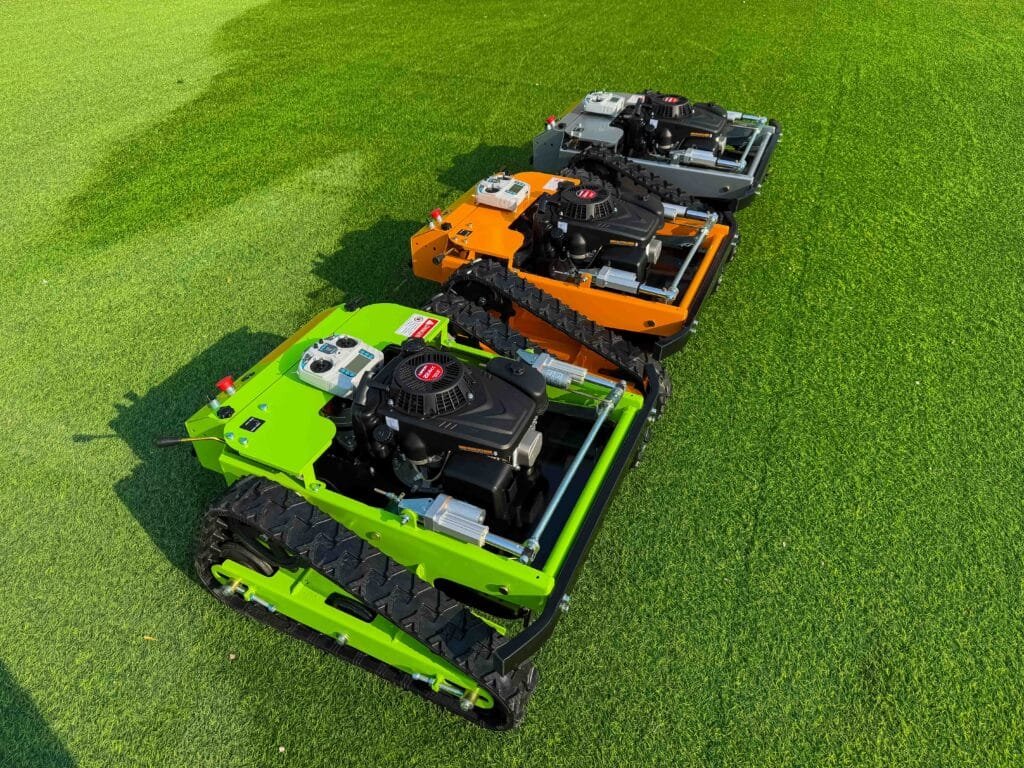
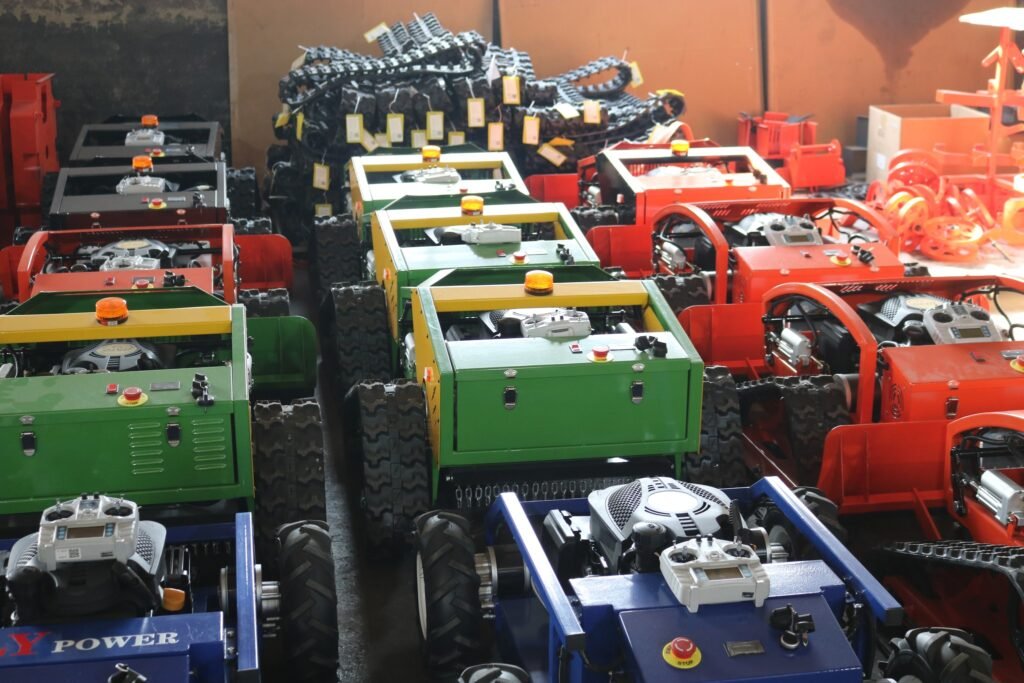
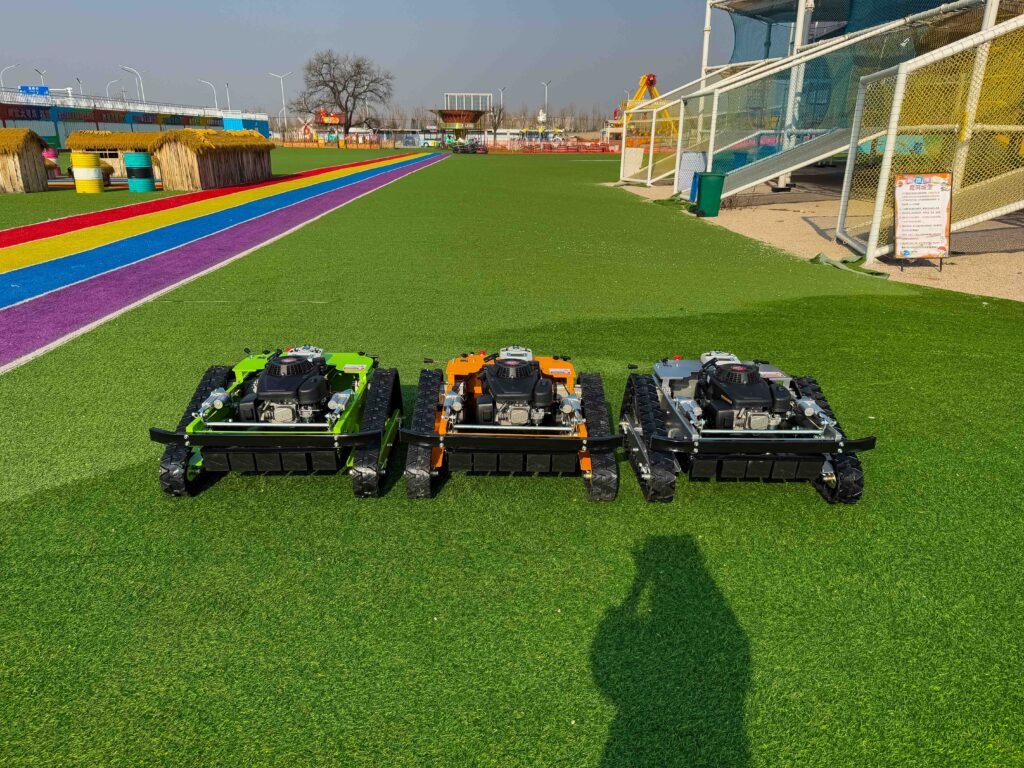
A low, tracked or 4-wheel mower with a gasoline or electric drive, controlled by radio remote, designed for steep or awkward areas.
Typical features from current Chinese manufacturers include:
- Crawler or 4WD wheel drive – low centre of gravity, good grip on slopes.
- Engine / power
- Gasoline 7.5–16 HP engines on compact crawlers (Nicosail-style units).
- 3.6–4.8 kW electric drive with 24–48 V lithium batteries on higher-end models.
- Cutting width
- Small units: around 500–600 mm
- Larger units: 800–1100 mm for faster coverage
- Cutting height: roughly 20–120/150/180 mm adjustable by remote or manual crank.
- Slope ability
- Wheel mowers: around 30°
- Tracked mowers: up to 45° on some models
- Remote distance: up to about 400 m quoted (realistic safe working distance is much closer).
Typical applications
Chinese suppliers themselves list almost the same set of jobs: garden lawns, soccer fields, golf courses, road banks, slopes, orchards, greenhouses, solar plants, farms and “ecological gardens”.
So if a buyer is:
- A distributor / rental company – these machines replace manual brushcutters on dangerous slopes.
- A farmer or orchard owner – they keep grass down under trees and along ditches.
- A solar or road maintenance contractor – they reduce risk on embankments and along rails or highways.
Then Chinese RC mowers are exactly the category to look at.
2. 2025 price levels: what different machines really cost
2.1 Ballpark machine prices (FOB or ex-works China)
Based on current public dealer pricing and factory websites as of late 2025:
- Small gas crawler (≈500 mm cut, 7.5 HP)
- Typical spec: 500 mm width, 20–150 mm cutting height, 7.5 HP engine, about 3 km/h travel, 1000–1300 m²/h efficiency, 100–160 kg machine weight.
- Indicative factory price: roughly US$1,200–1,800 per unit (FOB/ex-works), depending on engine brand and options.
- Mid-size crawler (600–800 mm cut, 9–16 HP)
- Example: an 800 mm tracked mower with around 16 HP, stronger frame, 2200 m²/h efficiency, 240 kg weight.
- Indicative range: US$2,000–3,500 from most serious manufacturers.
- Battery RC mowers (550–1100 mm cut, lithium battery)
- Example: the R1100E-48 remote electric crawler with 1100 mm width, 48 V 140 Ah ternary lithium pack, rated 8 h work, 0.71 acre (≈2800 m²)/h capacity, CE and EPA certificates, listed at US$4,600.
- Smaller 550 mm electric crawlers sit around US$3,600–3,800 retail from factory webshops.
So in short:
- Entry-level Chinese gas RC mowers: from around US$1,200
- Mainstream commercial gas units: US$2,000–3,000
- Premium lithium battery RC mowers: US$3,600–4,600+
For a B2B buyer, distributor margin and local costs will sit on top of this.
2.2 What really drives the price
If two machines look similar but one is 30–40% more expensive, it’s usually because of:
- Engine type & emission level
- Euro V / EPA-certified gasoline or diesel engines cost more than generic domestic engines, but are mandatory for legal import in many markets.
- Battery pack
- Lithium packs rated 24–48 V, 120–140 Ah with 8000–10,000 charge cycles add a big chunk to BOM cost.
- Cutting width and structure
- Going from 500 mm to 800–1100 mm needs a larger deck, heavier frame, more powerful motor and usually heavier tracks. Productivity rises a lot, but so does machine cost.
- Certification and documentation
- Proper CE under the Machinery Directive, plus EPA/Euro V engine certificates and full manuals/parts lists, require type testing and engineering work.
- Options
- Electric start, upgraded remotes, telematics, bigger fuel tank, snow blade, or extra blades and parts all move the quote.
2.3 “Total landed cost” – not just the machine
For importers, “cheap mower price” doesn’t equal “cheap project”. Typical extra costs:
- Ocean / rail freight or DDP air-sea combo
- Import duty and VAT, based on HS codes such as 8433.19.00 used for mowers and similar machines
- Customs broker fees and port charges
- Inland trucking from port to warehouse
- Your own branding, PDI, spare parts stock
Some Chinese suppliers now offer door-to-door (DDP) shipping, bundling freight, customs and last-mile transport into one price, as seen in RC mower sellers that explicitly advertise “Door to Door Delivery Service” along with customs & tax support.
For a realistic business plan, many distributors assume:
Machine price × 1.4–1.8 = landed cost into warehouse, depending on destination.
3. Key specs that matter (and how to read them)
Spec sheets can look overwhelming, but for RC mowers there are a handful of numbers that really decide whether the machine suits the job.
3.1 Cutting width & mowing efficiency
- 500 mm class – good for small slopes, orchards, around obstacles. Example Nicosail-type models quote 500 mm width with approx. 1000–1300 m²/h mowing efficiency.
- 600–800 mm class – for mid-size contractors and farm owners; efficiency often around 2000–3000 m²/h.
- 1000–1100 mm electric class – high productivity; example R1100E-48 does ≈2800 m²/h (0.71 acre/h).
Rule of thumb:
To keep labour cost low, aim for at least 2000 m²/h for commercial slope or solar work, unless the sites are very small.
3.2 Cutting height range
Most Chinese RC mowers offer something like:
- 20–120 mm or 20–150/180 mm adjustable cutting height
- Controlled via remote lift on the deck on better machines, or by manual screw adjustment on simpler ones.
For rental fleets and contractors, remote adjustment saves a lot of time and avoids operators constantly bending down near the blades.
3.3 Slope capability
This is one of the biggest selling points – and biggest risks – of these machines.
From real product data:
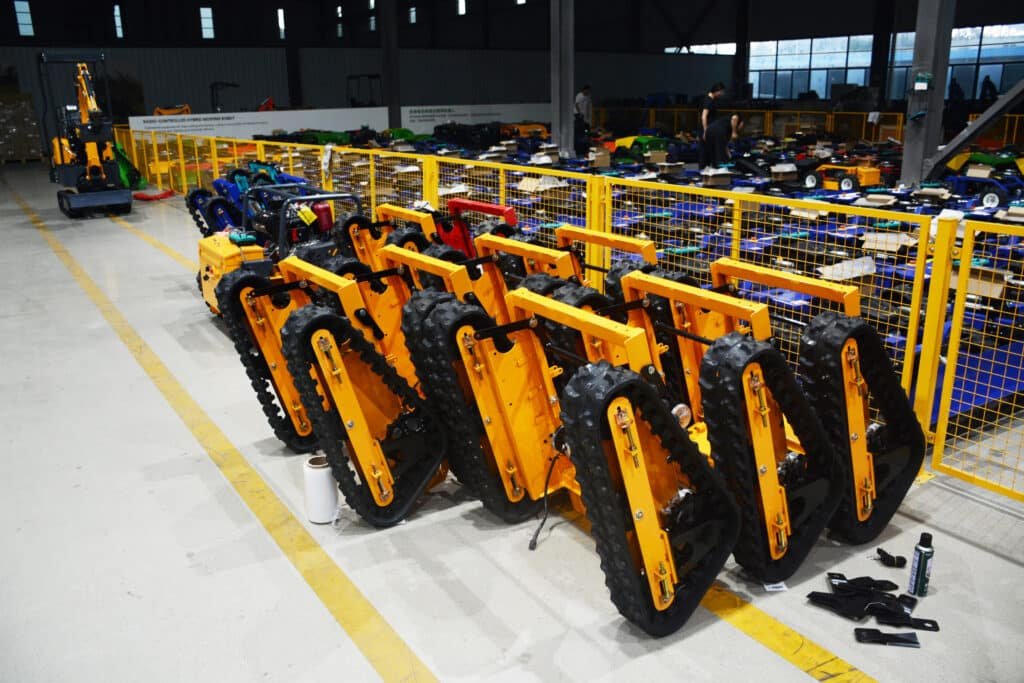
- Crawler mowers like Nicosail’s larger models quote 30–45° climbing ability, depending on variant.
- Electric tracked models like the R1100E-48 state max working slope 45°.
However, safe practice is:
- Work well below the absolute maximum, especially on wet grass.
- Focus not only on slope angle, but also:
- Ground roughness
- Weight distribution
- Whether the slope has “shoulders” or sudden drops.
3.4 Engine power / battery capacity
Gasoline units
- Common range: 7.5–16 HP petrol engines.
- Nicosail-type 500 mm crawlers: 7.5 HP; 800 mm models: about 16 HP with larger fuel tanks (e.g. 7.1 L).
Battery units
- Example R1100E-48:
- 48 V 140 Ah lithium battery
- Brushless cutting motor, separate drive motor
- 6 h charging, 8 h work time claimed
For buyers:
- Small private property / noise-sensitive city areas → battery makes sense despite higher ticket price.
- Rough, remote slopes with long daily hours → gas is still more common due to quick refuelling and simple infrastructure.
3.5 Size, weight and transport
Typical numbers from current products:
- Small 500 mm crawlers:
- Dimensions ≈ 930×860×580–640 mm
- Weight 100–160 kg
- 800 mm crawler:
- ≈ 1070×1230×670 mm
- Weight around 240 kg
- 1100 mm electric crawler (R1100E-48):
- ≈ 1500×1200×800 mm
- Weight about 300 kg
Why this matters:
- Heavier machines grip better on slopes but need better ramps and trailers.
- Check package size and weight as well – this affects shipping cost and what kind of forklift or pallet jack is needed at receiving.
3.6 Remote control & safety features
Better RC mowers now include:
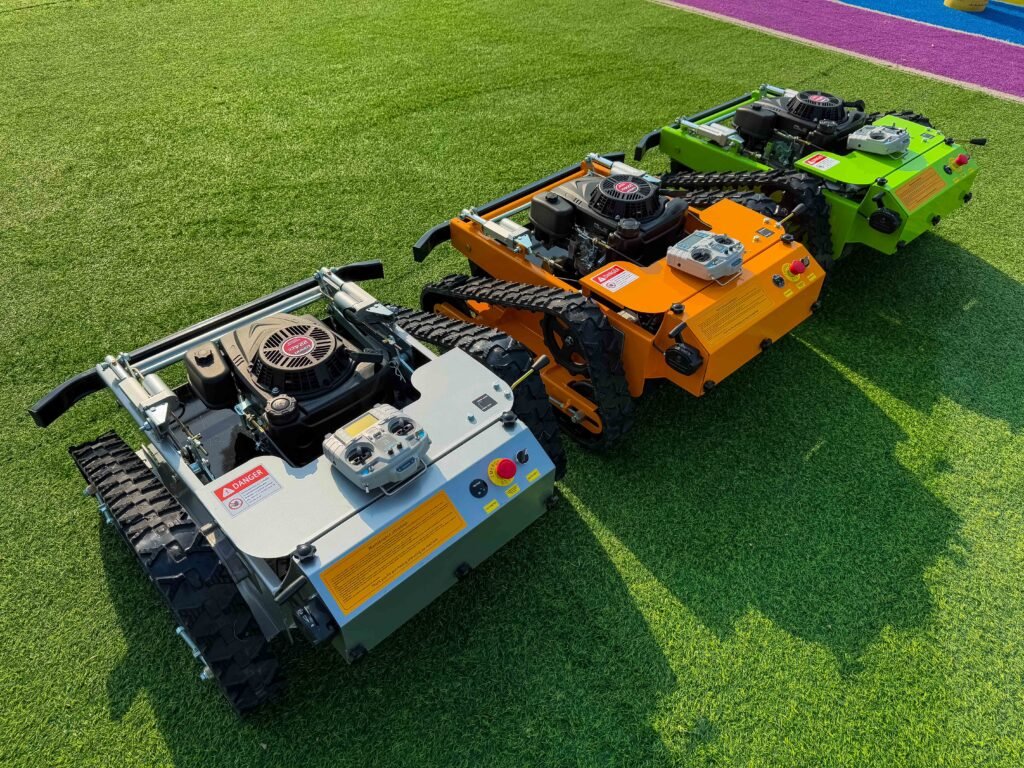
- 2-joystick transmitter (forward/back & left/right)
- Speed toggle (high/low)
- Deck lift switch
- Emergency stop / kill functions
- On some electric models, automatic shut-off on tipping and remote lockout for safety.
Buyers should:
- Ask for the remote control manual in advance.
- Confirm there is a clearly labelled E-stop on both the machine and the remote.
4. Safety and reliability: what photos don’t show
Many complaints on western forums about “cheap Chinese tracked mowers” are not about the concept, but about safety and durability when the buyer didn’t check enough details up front.
4.1 Pre-operation safety basics
A Chinese safety guide shared by RC mower specialists breaks operation into simple steps:
Before every job:
- Check fuel level and engine oil; use appropriate unleaded petrol or follow engine spec.
- Turn on the main power switch and quickly test the start button / starter.
- Wear PPE:
- Cut-resistant gloves
- Goggles
- Dust mask
- Secure long hair and loose clothing
During operation:
- Start from a safe distance (around 3 m or more) and let the engine warm for a couple of minutes.
- Avoid standing in front of or directly behind the machine.
- Take 10-minute cooling breaks after long continuous work to avoid overheating.
Maintenance:
- Check blades after each job; replace if curled or cracked.
- Keep machine clean of grass buildup to avoid fire and overheating.
These are simple things, but they show in accident statistics and warranty claims.
4.2 Structural details to pay attention to
When evaluating a Chinese RC mower, especially direct from factory, look beyond the paint:
- Track / wheelbase width – wide stance = better lateral stability on slopes.
- Deck shielding – strong skirts and guards reduce thrown object risk.
- Blade type & hub – flail vs fixed blade, and how easily it can be replaced.
- Welds on frame and deck – should be continuous and neat around high-stress zones.
- Cable routing and hydraulic lines (if any) – avoid sharp edges and tight bends.
4.3 Remote, electronics and “hidden” reliability
Remote-controlled mowers live or die by electronics:
- Ask what brand of controller, receiver and ESC / speed controller is used.
- See if spare remotes and controllers are standard parts on the supplier’s site (RClawnmowers, for example, lists speed controllers, chargers, generator, tracks and blades as catalogued parts).
Red flag signs:
- No spare parts catalogue or only generic promises.
- No warranty statement on electronics.
- Remote has no clear emergency-stop.
5. CE, EPA and emissions: staying legal in the US, EU & Canada
For 2025, compliance and documentation matter more than ever – especially with increasing pressure on small gasoline engines.
5.1 CE marking for the EU and UK
For export to the EU, RC mowers fall under the Machinery Directive 2006/42/EC (moving to a Machinery Regulation). The directive harmonises safety requirements and enables free movement of compliant machinery within the EU market.
Key points:
- CE mark shows that the mower meets EU safety, health and environmental protection requirements.
- The CE marking must be visible, legible and indelible on the machine, placed near the manufacturer’s nameplate.
- For powered mowers, harmonised standards cover mechanical safety, electrical safety, noise, and (for robotic mowers) specific performance requirements.
Many Chinese RC mower suppliers now highlight CE conformity in their product info. The R1100E-48, for example, explicitly lists CE (2006/42/EC) along with HS code and technical data.
Buyer checklist for CE:
- Ask for the EU Declaration of Conformity (DoC) listing:
- Manufacturer’s name and address
- Applicable directives (Machinery, EMC, etc.)
- Applied standards and notified body if used
- Model name identical to the nameplate
- Request the risk assessment summary or at least confirmation that it exists.
- Check that the CE plate on the sample uses the same model code as in documents.
5.2 EPA, Euro V and small-engine emissions
For the US and Canada:
- The US EPA has long-standing rules on small spark-ignition engines ≤19 kW, covering lawn & garden machinery.
- Canada’s Off-Road Small Spark-Ignition Engine Regulations largely align with EPA standards.
Battery RC mowers like R1100E-48 also frequently advertise EPA emission certificates and Euro V when hybridised with petrol engines, making them easier to import and register.
On top of that, in 2025 California has moved to ban sales of many small gas engines in lawn and garden equipment, aiming for zero-emission units, with EPA granting waivers to enforce stricter rules.
For US distributors, this means:
- Battery or hybrid RC mowers are becoming more attractive, especially for states following California’s lead.
- Any gas-only mower must come with proper EPA family certification for the engine.
5.3 How to catch fake or weak certificates
Practical steps suggested by import specialists and buying guides:
- Ask early – request PDFs of:
- CE Declaration of Conformity
- Engine EPA certificate or CARB where relevant
- Test reports (from labs like TÜV, SGS, etc.)
- Check consistency
- Model code and engine type on docs must match the nameplate and engine sticker.
- Manufacturer or authorised representative address on document should match real company details.
- Cross-verify engine certificates
- Where possible, check the engine model in EPA or local databases, or contact the engine brand directly.
- Avoid “blank” certificates
- If you see generic templates with no serial numbers, mismatched photos, or weird fonts, treat them as suspect.
Doing this once, at the start of a relationship, saves a lot of pain later.
6. Factory vs trading company: who should supply your mower?
The Chinese RC mower industry is a mix of:
- Specialised mower factories with their own brands, spare-parts catalogues and distributor networks.
- General machinery groups that make mini excavators, loaders and RC mowers under one roof.
- Pure traders who remarket various factories’ machines.
What matters to a buyer is not the label, but:
- Can the supplier provide full technical data and manuals?
- Do they have standard spare parts (blades, belts, tracks, remotes) in catalogue form?
- Is there a written warranty and after-sales process? Many serious factories give 1-year warranty and free online support on mowers.
For B2B distributors and rental fleets, partnering with a factory group that already builds mini excavators, skid steers and RC mowers can be a big plus, because:
- They understand hydraulics, structures and powertrains.
- Custom colour, logos and even local brand labels (OEM/ODM) are often standard options.
Nicosail is a good example of this “full range” style: excavators, loaders and remote-control mowers under one brand, with OEM/ODM support and 1-year warranty, as shown on its remote mower description.
7. On-site testing checklist before you release the balance
Whether the machine is shipped as a sample or a full batch, it’s smart to do a structured test before final payment.
Here’s a practical checklist (adapt as needed):
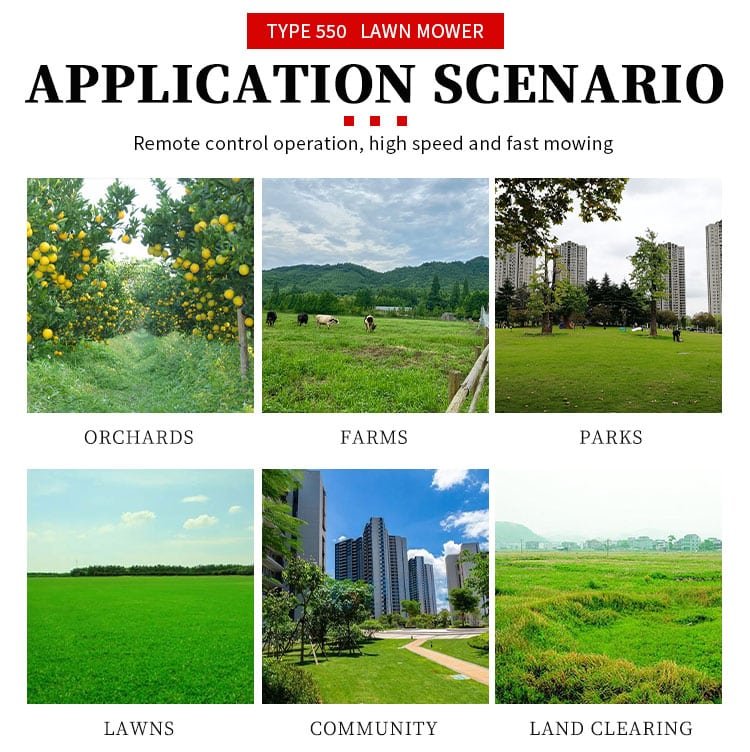
7.1 Visual and basic checks
- Confirm model nameplate matches the PI and certificates.
- Check CE mark, serial number and engine label are present and legible.
- Inspect welds on:
- Chassis
- Track supports
- Deck frame
- Check that blades, belts and tracks are correctly installed and tensioned.
7.2 Remote & safety
- Pair the remote following the manual (often: key on, lever back, press remote power; a “beep” confirms pairing).
- Test:
- Forward/back, left/right
- Speed switch (high/low)
- Deck lift up/down
- Emergency stop on both machine and remote
- Walk away in stages (20 m, 40 m, 60 m) and confirm stable control – no dropouts or lag.
7.3 Cutting and slope test
- Mow a patch of typical grass:
- Check actual cutting width with a tape measure.
- Try 2–3 different cutting heights and confirm the range matches the spec.
- For slopes:
- Start gentle (10–15°), then go steeper.
- Watch for track slip, nose lift or engine bogging.
- Never jump straight to the maximum rated angle – leave safety margin.
7.4 Endurance and heat
- Run the machine for at least 30–60 minutes at working load:
- Listen for abnormal noise or vibration.
- After stopping, check:
- Engine / controller temperatures
- Fuel consumption tracking vs catalogue numbers (approximate)
- Any oil or fuel leaks
7.5 Documentation and spares
Before signing off:
- Confirm the crate contains:
- Operator’s manual
- Parts list / exploded diagrams
- Warranty card and contact info
- Spare blades and basic tools, where promised
- Get a spare parts price list (tracks, belts, remote, batteries, controllers).
This is exactly the kind of diligence that separates smooth long-term cooperation from the horror stories that sometimes appear on forums.
8. Shipping, lead time and avoiding peak-season delays
One of the biggest pain points western buyers mention is late deliveries and missing peak season.
From actual sellers:
- Retail platforms like Afrimart show 2–5 days order processing, plus 35–60 days delivery, and note that some products require an extra 10–30 days manufacturing time depending on demand.
- RC mower factories like RClawnmowers highlight the ability to offer door-to-door delivery, HS code documentation, and custom import tax guidance.
So a realistic timeline for a new RC mower model is:
- Sample / first order
- 10–30 days production
- 30–45 days sea shipping
- Repeat order
- 7–20 days production (if standard colour/spec)
- 30–45 days shipping
To avoid missing the mowing season:
- Plan purchase at least one full quarter ahead of peak.
- For distributors, consider off-season stock of key models (e.g. 500 mm and 800 mm crawlers) and order replenishment while still in season.

9. Where Nicosail-type remote mowers fit in the market
Without turning this into an advertisement, it helps to use one brand as a concrete example of what a mature Chinese supplier can offer.
On third-party platforms, Nicosail remote-controlled mowers are described roughly as follows:
- Power & sizes
- Engines from 7.5 HP to 16 HP
- Cutting widths 500–800 mm
- Cutting performance
- Cutting height 20–120/150 mm
- Max cutting height around 150 mm
- Efficiency 1000–3000 m²/h depending on model
- Terrain
- Wheel mowers for flatter lawns
- Crawler mowers rated to 30–45° slopes
- Operation
- Fully remote-controlled driving and deck lift
- Remote joystick layout similar to RC excavators
- Endurance
- Gas units with fuel tanks around 1.2–7.1 L and quoted 20 hours endurance (with refuelling).
- Service
- 1-year warranty cited
- OEM/ODM (colour, brand label) available for distributors
For distributors, this type of product positioning is attractive because:
- Machines sit in a mid-price bracket – not as expensive as some western brands, but with serious specs.
- Brand can be applied onto the machine, packaging and marketing material.
- A factory like Nicosail already builds excavators and loaders, so they understand export documentation and quality systems.
For farm and garden owners buying one or two units, the benefit is simpler:
- A reasonably priced slope mower with decent specs, existing export track record, and a spare-parts line behind it.
10. Quick matching guide: which mower for which job?
Think in terms of terrain + area + compliance.
A. Distributors / rental fleets
- Target customers: contractors, municipalities, farmers
- Recommended:
- One 500–600 mm crawler as compact all-rounder
- One 800–1100 mm crawler for heavy work and solar farms
- At least one battery RC mower in markets with strict emission rules (California, some EU areas).
B. Farmers & orchard owners
- Terrain: uneven, with ditches, orchards, banks
- Recommended:
- Crawler type with 500–800 mm width depending on field size
- Gasoline engine acceptable if local emissions rules allow
- Strong blade and deck design to cope with rough grass and small brush
C. Landscape / road / solar contractors
- Terrain: long slopes, road shoulders, under solar arrays
- Recommended:
- 800–1100 mm crawler, gas or electric
- Verified 45° slope rating and robust track system
- Clear CE and, if needed, EPA / Euro V support
D. Large property / estate owners
- Terrain: mixed lawns and embankments
- Recommended:
- 500–600 mm crawler, ideally electric for noise and emissions
- Focus on simple remote, easy maintenance, and local parts support.
11. Frequently asked questions
Q1. Are Chinese remote-controlled lawn mowers reliable?
They can be. Some factories have been exporting RC mowers for years, with full parts catalogues and dealer networks.
Reliability depends heavily on:
- Whether the factory actually builds the mower vs just trading.
- The engine / battery brand and certificates.
- How strictly the machine is maintained (blades, belts, oil, cleaning).
With proper screening and a structured test as described above, many buyers run these machines commercially without major problems.
Q2. Gasoline vs battery: which should be chosen?
Choose gasoline if:
- Sites are remote, with no easy power supply.
- Workdays are long and refuelling is easier than charging.
Choose battery if:
- Noise and emissions are sensitive (cities, golf courses, near residences).
- Local rules push toward zero-emission equipment, as in California’s small-engine policies.
Battery mowers cost more upfront but reduce fuel use and may be easier to deploy in regulated markets.
Q3. What slope can these mowers safely handle?
Many tracked RC mowers quote max 45° slopes, but safe practice is to work at a lower angle and keep operators away from the fall line.
Factors that affect real-world slope ability:
- Grass moisture (wet grass is slippery)
- Soil condition
- Machine weight distribution
- Operator skill with remote (smooth throttle and steering)
Q4. How about warranty and spare parts?
Serious manufacturers typically offer:
- 1-year warranty on the machine
- Free online technical support
- A standard list of spare blades, belts, tracks, controllers, chargers available for order.
Before buying, ask for:
- Written warranty policy
- Spare parts price list
- Typical lead time for parts orders.
Q5. How to avoid certificate fraud?
Short version:
- Ask for DoC, EPA certificates and test reports before ordering.
- Check that model, engine and manufacturer match across machine, documents and labels.
- For big orders, consider having a third-party inspection verify labels and documentation against your requirements.
Q6. How often do RC mowers need maintenance?
Daily / per-job:
- Inspect and clean deck & undercarriage
- Check blades for damage
- Check for leaks
Periodic (following manufacturer guidance):
- Blade sharpening / replacement
- Oil and filter changes (gas engines)
- Battery health check and connection tightening (electric)
- Track tension adjustment
Guides from manufacturers and safety experts emphasise regular cleaning, blade checks and battery maintenance to keep both safety and uptime high.
12. Final summary
In 2025, Chinese remote-controlled lawn mowers have matured into serious professional tools:
- Prices run from around US$1,200 for small gas crawlers up to US$4,600+ for large lithium-powered tracked mowers.
- Key buying decisions revolve around cutting width, slope rating, power type, and certifications (CE, EPA, Euro V).
- Safety and reliability depend less on the country of origin and more on supplier strength, documentation quality and maintenance habits.
Brands like Nicosail represent a newer generation of Chinese factories that combine proper engineering, OEM/ODM options, and export-ready documentation for remote-control mowers, excavators and loaders.
For distributors, rental fleets and farm or construction users, the smartest approach is:
- Define terrain, area and legal requirements (CE/EPA/zero-emission).
- Shortlist 500–600 mm and 800–1100 mm crawlers that match those needs.
- Vet the supplier on certificates, parts and after-sales.
- Do a thorough on-site test before paying the final balance.
Handled this way, a Chinese remote-controlled mower can be a safe, compliant and very profitable piece of equipment – instead of just another risky internet experiment.
Further reading on small‑engine emission rules and zero‑emission trends


