Introduction
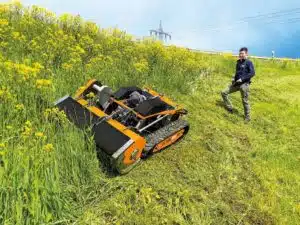
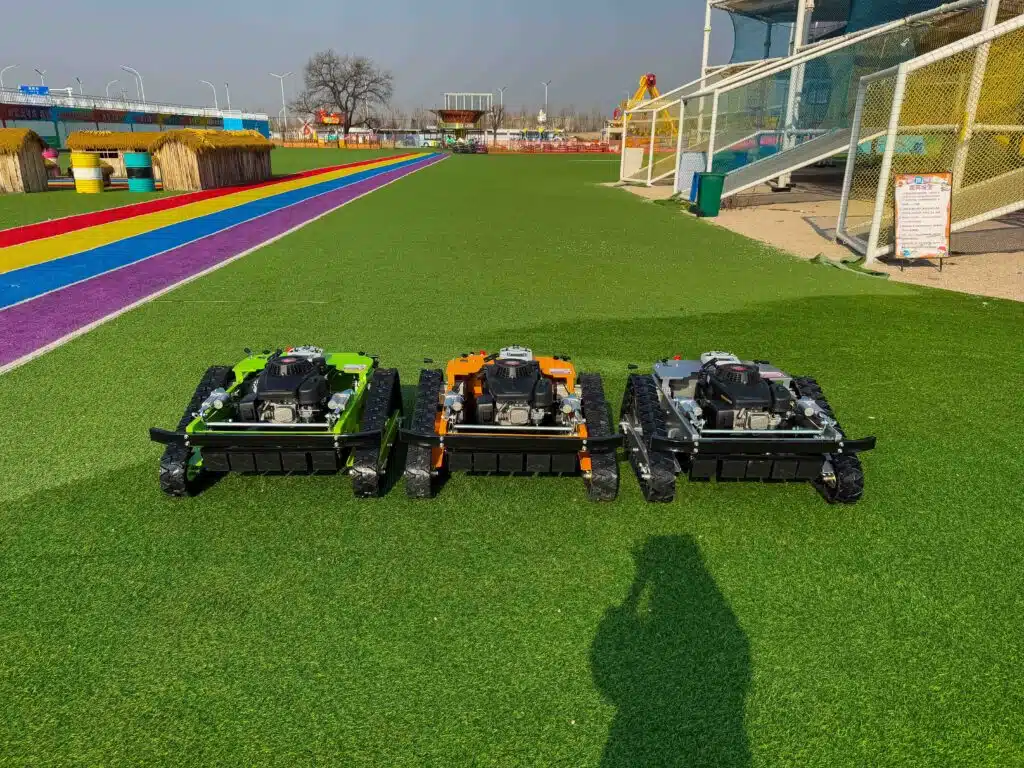
In recent years, remote-controlled (RC) and autonomous lawn mowers have begun to reshape the landscape of lawn care services. Instead of relying entirely on manual labor or expensive commercial ride-on mowers, lawn care businesses can deploy RC mowers to cut costs, increase efficiency, and reduce fatigue among workers. As the technology matures, many Chinese manufacturers are offering competitively priced, feature-rich RC lawn mowers that appeal to both startups and established lawn care operators.
However, choosing the right China-made RC mower for your business is not trivial. You must balance cost, reliability, support, and performance under real-world conditions. In this article, we will walk you through all the critical factors to consider, with practical tips and a final checklist to guide your decision. I will mention Nicosail as one of the emerging names in this space, but the goal is to help you choose the best option — not push a single brand.
1. Understand Your Business Needs
Before you even look at model specifications, the most important step is to clearly define your operational requirements. This will narrow down which RC mowers are realistic fits.
Lawn Size & Terrain
- If your typical service area is small residential lawns (500–2,000 m²), a lighter, narrower mower may suffice. But for commercial parks, university grounds, or golf courses, you’ll need larger cutting widths and longer endurance.
- Consider distribution of lot sizes: e.g. 70% small lawns + a few large parks.
Job Volume & Frequency
- How many jobs per day or week? If your schedule demands tight turnarounds, you need machines that can do multiple zones per charge (or easily swappable batteries).
- Also, factor travel time between sites.
Grass Type & Obstacles
- Some grasses are tougher or thicker (e.g. fescue, kikuyu). Your mower must have sufficient power and blade design.
- Many sites have trees, shrubs, playground equipment, paths, or uneven edges.
Labor Cost & Strategy
- One of the selling points of RC mowers is reducing labor intensity and risk. But if labor is cheap in your region, the ROI timeline may shift.
- Decide whether to run a mix: manual crews for tight spots + RC mowers for open areas.
Once you document your business needs, they become your baseline to evaluate technical specs.
2. Key Technical Specifications to Evaluate
Now let’s break down the core metrics you’ll see in product catalogs and how to interpret them.
Cutting Width & Efficiency
- Wider cutting width means fewer passes and faster coverage, but also higher power demand and heavier build.
- The “area per hour” rating is more meaningful than just width — it factors speed and overlap.
Battery Runtime & Endurance
- Look for “continuous runtime” under realistic load, not ideal scenarios.
- Also consider usable runtime after accounting for reserve buffer (you don’t want your mower stranded mid-lawn).
- Some companies specify “coverage area per charge” — useful for comparing models.
Working Speed
- Speed determines throughput, but higher speed demands better stability and control.
- Balance speed vs cut quality (faster movement may reduce cut precision).
Slope / Grade Capability
- Many mowers struggle beyond ~15°–20° gradient. If your operation includes slopes, make sure the mower can grade, climb, and descend safely.
Durability & Maintenance
- Duty cycles, mean time between failure (MTBF), ease of replacing wear parts — these are key over the long run.
- Watch for “waterproofing / IP rating” especially if mowing early morning dew or in damp conditions.
3. Chassis, Materials & Build Quality
Even great specs mean little if the build is flimsy or ill-suited to real-world use.
Frame & Corrosion Resistance
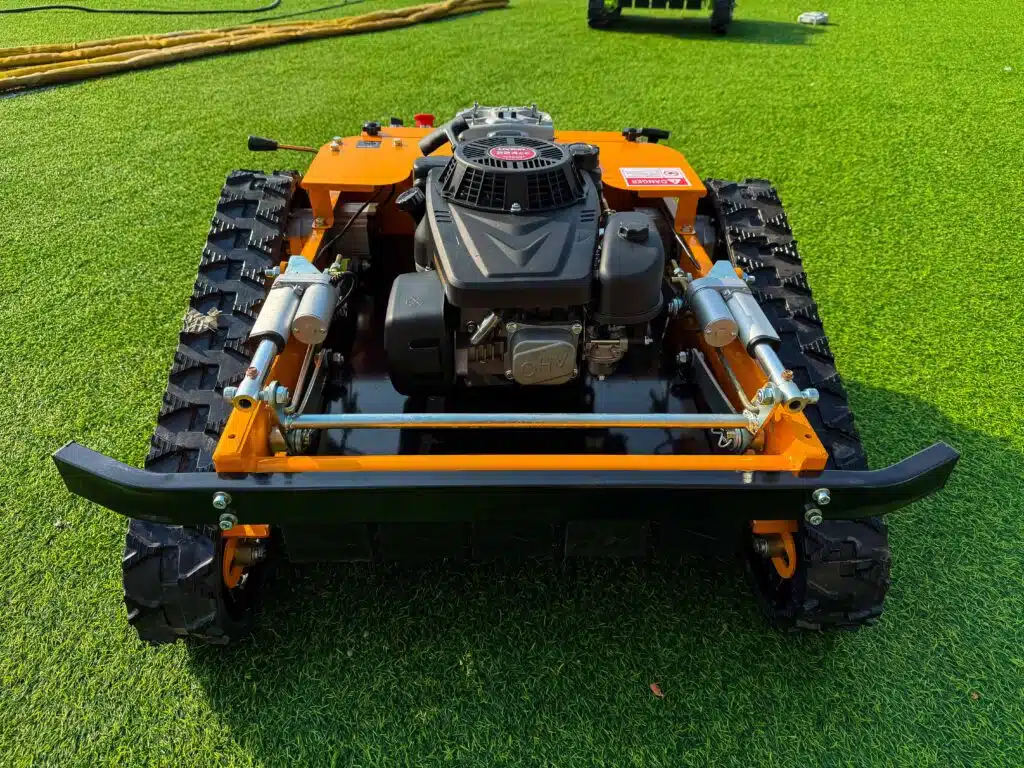
- Look for aluminum alloy, stainless steel, or powder-coated steel frames to resist rust.
- Check for proper sealing (gaskets, sealing of joints) to prevent ingress of grass, dust, or water.
Wheels, Tracks & Drive System
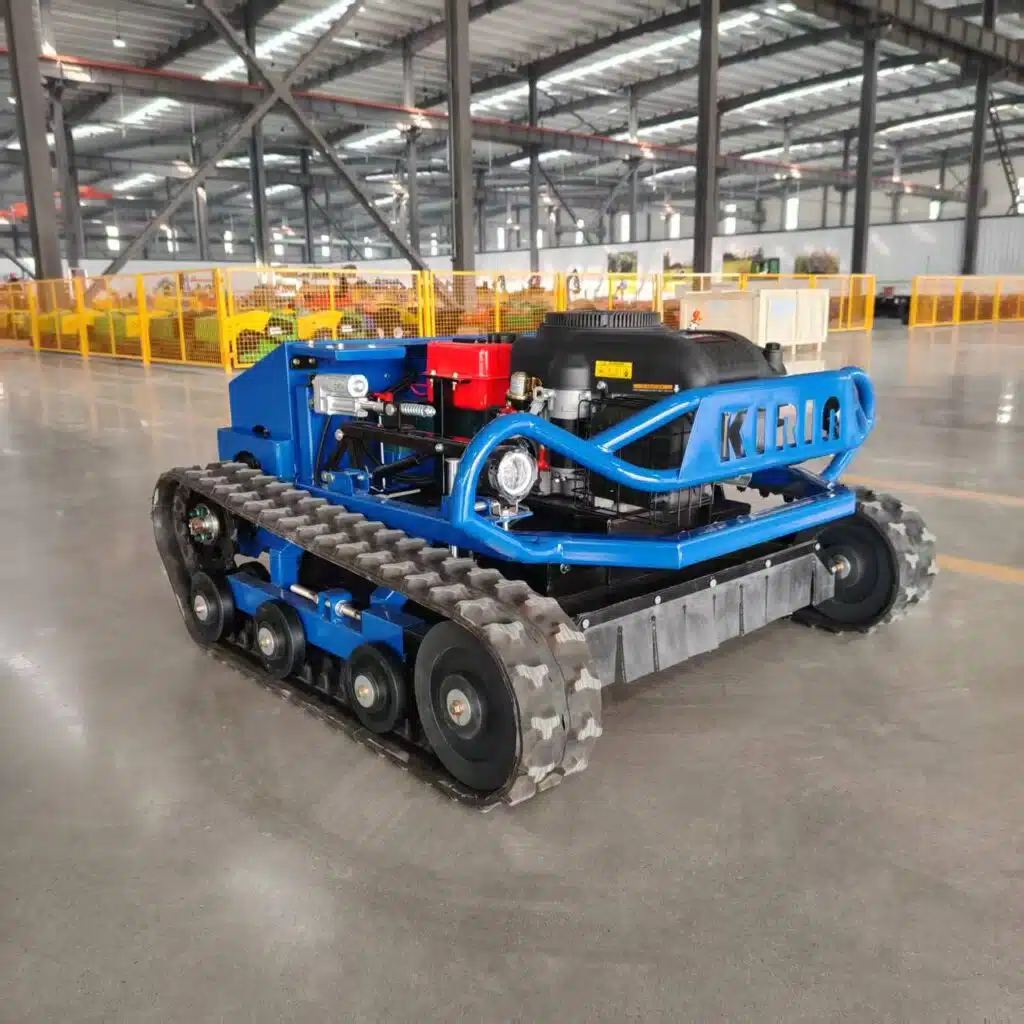
- Wheeled designs are simpler and lower cost, but tracks (or wide wheels) offer better traction, especially on slopes or wet ground.
- Suspension or shock absorbing components can improve ride over bumps.
Ease of Replacement
- Standardized parts (bolts, hubs, bearings) are easier to source locally.
- Modular design lets you remove and replace deck, battery modules, etc., with minimal downtime.
4. Drive & Control System
Your mower’s intelligence and control system define how easy and safe it is to operate.
Remote Control Range
- For many business use cases, a control range of at least 100–200 m is desirable. Some may use 500 m or more.
- Line-of-sight and interference (trees, structures) affect real range.
Autonomy & GPS Navigation
- Some RC mowers offer waypoint-based autonomous mowing: you program a route or boundary, then the mower follows it.
- Autonomy can reduce operator oversight, but demands robust obstacle detection and localization.
Fail-safe & Collision Avoidance
- Ultrasonic sensors, LiDAR, bump sensors, and computer vision help avoid obstacles or people.
- The mower should automatically stop or reverse when encountering unexpected objects.
Communication Technology
- RF (2.4 GHz, 5 GHz), WiFi, and even 4G/5G connectivity may be offered. Each has tradeoffs: range, reliability, interference.
- Encryption and communications security are important when operating in public areas.
5. Power & Battery System
Power system is often the heart and Achilles heel of RC mowers.
Battery Chemistry & Type
- Lithium-ion (Li-ion) batteries are common; LiFePO₄ tends to have longer cycle life and better thermal stability.
- Make sure cells are from reputable brands (LG, Samsung, Panasonic, etc.) and have proper BMS (battery management systems).
Capacity & Modularity
- A high capacity (kWh) translates to more runtime, but also adds weight.
- Modular battery packs allow for swaps in the field — reduce downtime if you carry spares.
Charging System & Strategy
- Fast charging (e.g. 0–80% in 1 hour) is ideal, but heat and battery degradation must be managed.
- Dual chargers or rapid charge stations may be beneficial for fleet operations.
Power Efficiency & Management
- Systems that reduce power draw on lighter cuts (e.g., eco mode) extend runtime.
- Regenerative braking or downhill energy recovery may be present in some designs.
6. Cutting & Deck System
How the mower cuts and deals with grass directly affects performance and finish quality.
Blade Type & Quality
- Look for hardened steel or coated blades to resist wear and corrosion.
- Some designs use multiple blades or overlapping discs to get smooth cuts.
Mulching, Bagging, Discharge Options
- Multipurpose decks (mulch + side discharge + bagging) increase versatility.
- Bagging adds weight and slows movement; side discharge or mulching can be preferable in many commercial contexts.
Deck Height Adjustment
- Fine-grained adjustment (e.g. 1 mm steps or 5–10 levels) is helpful for different grass heights.
- Electronic or remote-controlled adjustment is a plus.
Anti-Clog & Debris Management
- Decks with curved shapes or anti-clog conduits prevent grass clogging.
- Easy access for cleaning and removal of clippings is important.
7. Terrain Capability & Slope Handling
Your mower will face real ground conditions—soil softness, bumps, wet patches, etc.
Maximum Grade / Incline
- Check manufacturer specs for maximum grade. You may want a safety margin (e.g. spec says 25°, but you prefer 20°).
- Also consider descent braking (going downhill) — traction and stability are essential.
Traction / Wheels / Tracks
- Deep-tread tires or tracks give better grip in wet or loose soil.
- Lower ground pressure (wider tires or tracks) helps on soft ground to avoid sinking.
Clearance & Undercarriage Design
- Sufficient ground clearance prevents catching on roots or hidden objects.
- Underbody protection / skid plates help when crossing rough terrain.
8. Safety & Certifications
Operating unattended or semi-autonomously demands strict safety measures.
Emergency Stop & Kill Switches
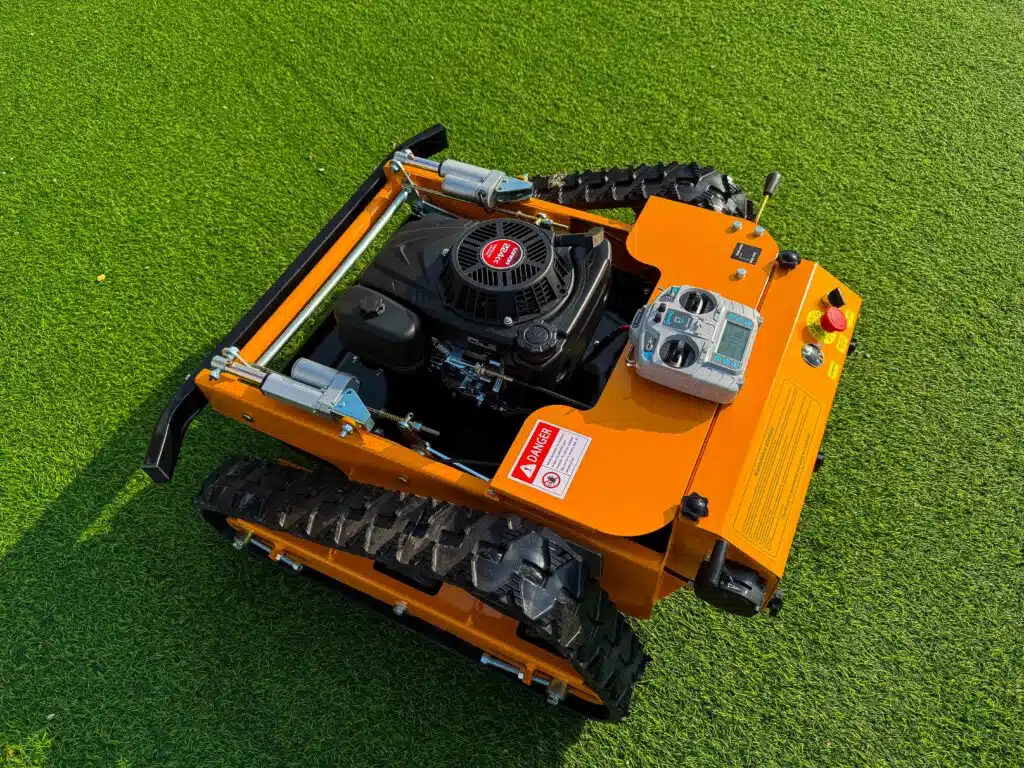
- Operator must be able to instantly halt the mower. Physical buttons, remote commands, or tilting sensors are useful.
Blade Guards & Protective Covers
- Covers over blade housing, guards around exposed edges.
- Ensure there is a mechanism to shut off blades if mower tips or is lifted.
Sensors & Object Detection
- Proximity sensors to detect humans, pets, objects.
- If possible, use multi-modal sensing (ultrasound + lidar + camera) for redundancy.
Certifications & Compliance
- CE, FCC (if wireless), RoHS, EMC – check that the model is certified for your markets.
- Local safety and robotic mower regulations may apply (e.g. required fencing or signage).
9. Support, Parts & Warranty
A mower is useless if you can’t get parts or service when needed.
Spare Parts Availability
- Ensure the supplier can deliver replacement blades, belts, sensors, tires, motors, controllers, etc.
- Having local or regional stock (or partnerships in your country) shortens downtime.
Technical Documentation & Software
- Good user manuals, wiring diagrams, firmware update capabilities, troubleshooting guides.
- Access to software/firmware updates is essential — watch for “locked” or subscription-based systems.
Service Network & Technical Support
- Does the manufacturer or reseller provide service training? Remote support?
- Responsiveness matters — when your mower fails in the middle of a job, you want fast support.
Warranty Terms
- What does the warranty cover (motors, batteries, electronics, wear parts)?
- Duration, limitations (e.g. void if used on slopes above limit), shipping of warranty parts.
10. Cost & Total Cost of Ownership (TCO)
The least expensive unit may end up costing you more in the long run.
Upfront Cost vs Features
- A basic model may be cheap, but may lack durability, autonomy, or safety features.
Operating Cost
- Electricity (charging), maintenance (blades, bearings, belts), replacement parts.
- Downtime cost (lost productivity) is hidden but critical.
Spare Parts & Consumables
- Blades, tires, filters, electronics – see how expensive replacement is.
- Batteries degrade over time — factor in battery replacement cost.
Depreciation & Resale Value
- Better-built units tend to hold value.
- Try to get documentation or references for resale in your region.
ROI & Payback Period
- Estimate how much labor cost you save per month.
- Estimate how many months or years to cover the extra cost of RC implementation.
11. Manufacturer Reputation & Quality Control
Not all manufacturers are equal in consistency and trustworthiness.
Factory Audits & Certifications
- Ask for ISO 9001, or third-party quality audits.
- Insist on factory visit or third-party inspection (or at least photos/videos).
Customer Feedback & Reviews
- Search for existing users (in your country or region) to get real feedback on reliability, parts, and support.
- Request references or case studies.
After-sales & Long-Term Commitment
- Ensure manufacturer is committed to future development, firmware updates, spare parts over years.
- Beware of manufacturers that vanish or change product lines too quickly.
Sample Units & Pilot Testing
- Before placing a full order, buy one or two as samples and test them for weeks.
- Run them in your actual typical site to uncover weaknesses.
One brand you might come across in your research is Nicosail, which has been gaining attention in the RC mower industry for offering a balance of performance, modular battery packs, and mid-tier pricing. Use it as one comparison point, not the end-all, and always run your own sample tests.
12. Compliance & Import Considerations
Because you are sourcing from China, certain import & regulatory hurdles must be addressed.
Certifications (CE, EMC, RoHS, etc.)
- Ensure the units meet the relevant safety and electromagnetic standards in your country.
- Ask for test reports from accredited labs (e.g. Intertek, TÜV, SGS).
Import Duties & Tariffs
- Factor in import duties, VAT/GST, customs handling, shipping costs (air, sea) into landed cost.
- Sometimes duty savings come from designating products as “electric gardening equipment”.
Shipping & Logistics
- Bulk shipping (container loads) is more economical.
- Check for damage in transit; require sturdy packaging, internal bracing, shock sensors.
Legal / Regulatory Considerations
- Local rules may require signage or fencing when autonomous machines operate in public.
- Liability, insurance, and safety regulations might apply.
13. Deployment & Integration in Business Workflow
Once you have your RC mowers, integrating them effectively is key to success.
Job Scheduling & Fleet Management
- Use software to assign zones, monitor battery status, track completed jobs.
- Build buffer time for battery swaps, travel, charging.
Operator Training & Procedures
- Train your staff to handle deployment, monitoring, emergency override, basic maintenance.
- Safety protocols for humans, animals, bystanders.
Hybrid Fleet Strategy
- Use RC mowers for open zones, manual crews for tight or complex areas (edges, between obstacles).
- Use human crews for trimming, edging, spot work.
Monitoring & Telemetry
- Real-time status reporting (battery, fault codes, location).
- Use alerts for low battery, errors, deviations.
Warranty / Maintenance Workflow
- Keep logs for performance, maintenance, and failures.
- Manage replacement parts inventory.
- Plan for scaling: when you add more units, standardize procedures.
14. Case Studies & Use Scenarios
Below are illustrative scenarios showing how different types of lawn care operations might deploy RC mowers.
Residential Neighborhoods
- A business serves small lots ~800 m². A medium-sized RC mower with a cutting width of ~0.6 m, runtime ~90 min, and autonomy is ideal.
- The mower handles lawns; human crews handle edging and near obstacles.
Commercial Parks / Campuses
- Large campus areas (50,000–100,000 m²) require mowers with large coverage per charge, GPS scheduling, obstacle avoidance.
- Multiple mowers operate in parallel.
Slope / Hilly Terrain
- A resort or hillside neighbourhood has slopes up to 20°. Choose units rated for that grade, with tracked or high-traction wheels.
- Safety and descent control features are critical.
Fleet Deployment / Scaling Up
- A mid-size lawn care company deploys 10–20 RC units. They use centralized monitoring, standard procedures, and spare parts stock.
- They run pilot tests and phase deployments area by area.
These use cases show that the “right” mower depends heavily on your business profile — not just spec sheets.
15. Tips & Best Practices for Buying from China
To reduce risk and maximize success, here are some practical recommendations.
Factory Visits or Virtual Tours
- If possible, visit the factory or arrange a virtual walkthrough via video to inspect production lines, QA processes, and assembly standards.
Order Sample Units First
- Never commit to a large order without first purchasing one or two prototypes for long-term testing under real conditions.
Negotiate Terms
- MOQ (minimum order quantity), payment terms (30% deposit, 70% upon inspection), packaging, spare parts bundles.
Third-Party Quality Inspection
- Use a local QA agent or inspection firm in China to inspect units before shipping (check tolerances, alignment, electronics performance).
Long-Term Partnership & Rugged Contract Clauses
- Contract should specify warranty obligations, spare parts supply, software support, buy-back or upgrade options.
Staged Order Scaling
- Start small, test, then scale. Use initial units to refine operation and get feedback.
16. Cautionary Pitfalls & Red Flags
Be alert to warning signs when dealings with manufacturers or evaluating models.
Specs That Sound Too Good to Be True
- Unrealistic runtime + cutting width + slope handling combined — often marketing exaggerations.
- Ask for video proof or test reports.
Lack of Spare Parts or No Local Distributors
- If the manufacturer cannot supply or is vague on spare parts, that is a major red flag.
Locked or Proprietary Software
- If firmware or navigation software is locked or subscription-based, you may be stuck or incur recurring costs.
Weak Support / Slow Response
- If the manufacturer is evasive or slow in answering questions, that may translate to support failure later.
No Safety Features or Certifications
- If the machine lacks essential safety features, skip it — liability is too high.
No Pilot Test or Sample Refusal
- If the supplier refuses to provide a test unit or small trial, that suggests limited confidence in the product.
17. Conclusion & Final Checklist
Choosing the right China-made RC lawn mower for your lawn care business is a complex but manageable process. It demands aligning your business needs with machine capabilities, vetting manufacturers rigorously, and planning for integration and support.
Below is a final checklist to help you compare candidate models:
| Decision Item | Key Considerations |
|---|---|
| Business Fit | Lawn sizes, terrain, job volume, labor strategy |
| Cutting Specs | Width, speed, area per hour |
| Battery / Power | Chemistry, capacity, modularity, charger |
| Slope / Terrain | Grade capability, traction, clearance |
| Control / Autonomy | Remote range, GPS, obstacle avoidance |
| Safety & Certifications | Emergency stop, sensors, CE/FCC etc. |
| Durability & Build Quality | Frame, wheels, sealing, spare parts |
| Support & Warranty | Spare parts, software, response time |
| Cost & ROI | Upfront cost, TCO, labor savings, payback |
| Manufacturer Vetting | Audits, reviews, pilot orders |
| Compliance & Import | Duties, regulation, shipping |
| Deployment Workflow | Scheduling, training, hybrid usage |
| Red Flags | Overpromised specs, locked software, weak support |
In your evaluation, when you compare brands, treat Nicosail as one of many potential suppliers. If their specs, support, and terms match or exceed others, great — but don’t commit blindly. Always pilot-test, inspect, and verify claims under real working conditions before large-scale purchase.
If you like, I can also suggest specific China-made RC lawn mower models (including those from Nicosail and competitors) for your region, compare price estimates, or help you build a sample evaluation plan. Would you like me to do that next?