1. Quick Answer: RC vs Ride-On – Which Is Faster and Safer?
For flat, open, low-risk lawns (big yards, sports fields, parks), a ride-on mower usually cuts faster overall and gives the operator more comfort.
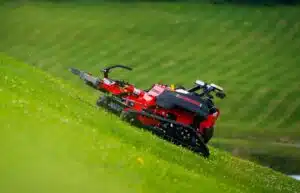
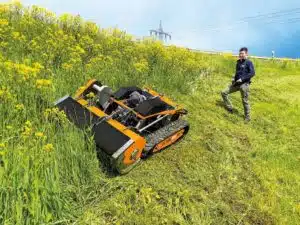
For slopes, banks, ditches, orchards and rough ground, a good Chinese RC tracked lawn mower:
- Cuts almost as fast as a ride-on in many cases
- Stays stable on slopes up to around 35–45°, where ride-ons are usually not recommended beyond about 12–15° according to manufacturer manuals and safety agencies
- Keeps the operator off the machine and away from rollovers, which is a major cause of serious injuries with ride-on mowers
So:
- Fastest overall on safe, flat lawn → Ride-on
- Fastest AND safest on slopes or dangerous terrain → Chinese RC slope mower
The rest of this guide breaks down the “why” behind that in simple, practical terms.
2. What Exactly Is a Chinese RC Lawn Mower?
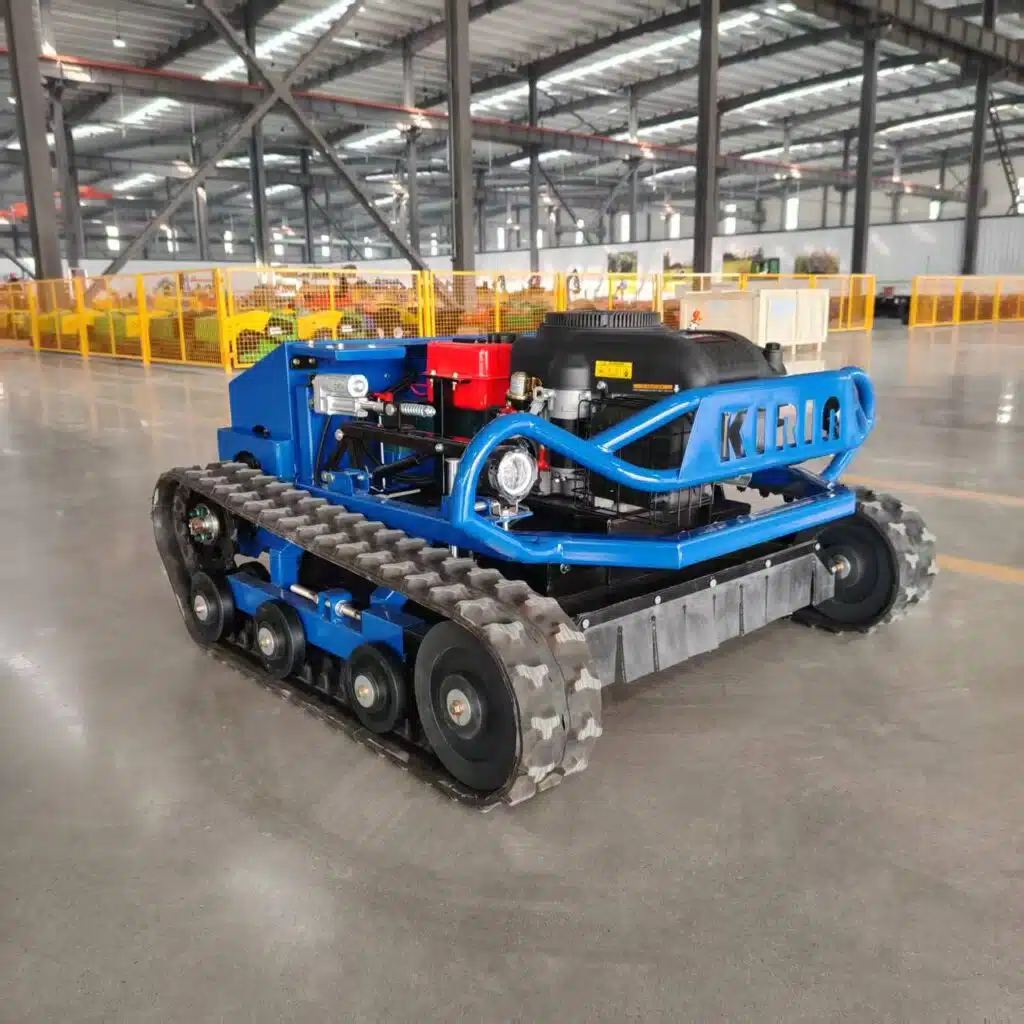
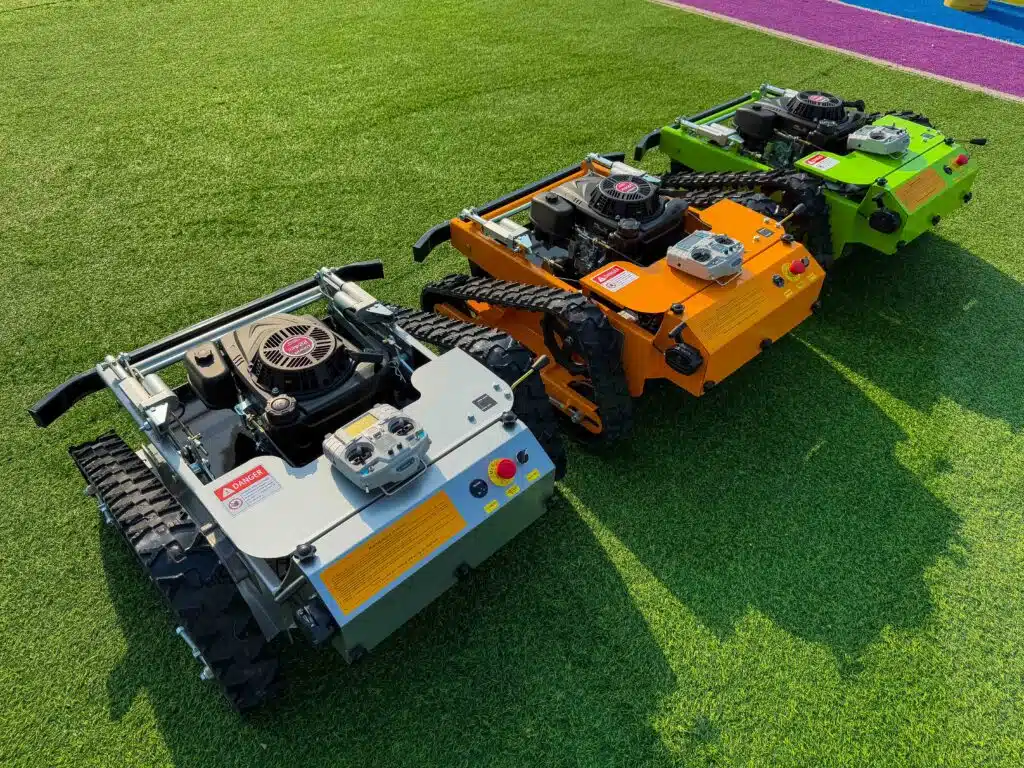
When people say “Chinese RC lawn mower” today, they usually mean a remote-controlled tracked slope mower:
- Crawler tracks instead of wheels
- Low, wide body with a gasoline engine and flail or blade deck
- Controlled by a handheld radio controller (often 100–200 m range)
- Designed to work on slopes, roadside banks, orchards, solar farms, rough grass
A typical Chinese RC mower from factories in Shandong:
- Power: 7.5–16 hp gasoline engine
- Cutting width: 500–800 mm
- Travel speed: about 3–5 km/h
- Slope capability: up to 45°
- Mowing efficiency: roughly 1,000–3,000 m²/h depending on deck width and grass height
These machines are built for hard, risky areas where sending a person on a ride-on is not comfortable – or simply not safe.
Chinese factories, including brands such as Nicosail in Shandong, now offer tracked RC mowers with CE/EPA/EURO 5-compliant engines, 500–800 mm decks, and 3–5 km/h travel speeds, mainly targeting European, North American and Australian users.
3. Ride-On Mowers in a Nutshell
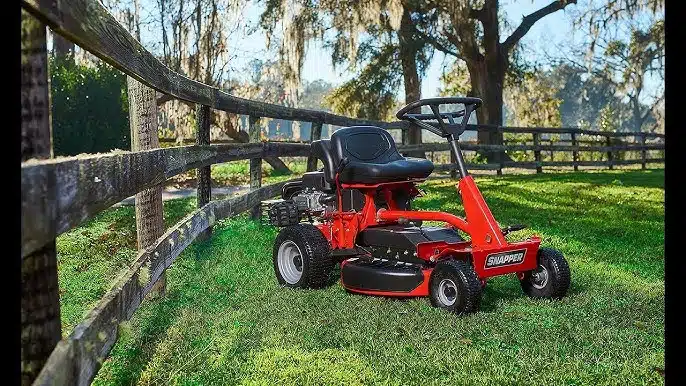
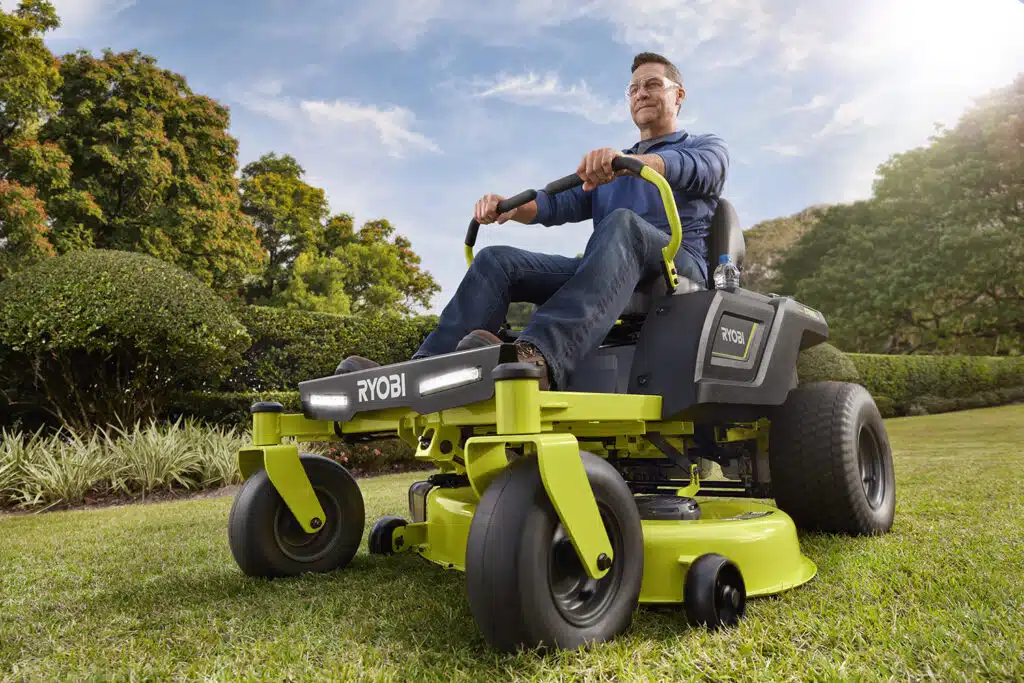
Ride-on mowers are the familiar sit-on machines used in big gardens, estates and commercial properties:
- Lawn tractors / riders with 60–110 cm cutting decks
- Usually faster ground speeds, often up to 10–13 km/h on flat lawns for mid- to high-end machines
- Comfortable seat, steering wheel or levers, sometimes cup holders and lights
- Great for large, safe, relatively smooth areas
Typical ride-on specs from mainstream brands:
- Cutting width: 67–122 cm
- Engine power: 10–24+ hp
- Max speed: around 6–13 km/h depending on model
But the key limit is slope. Many manuals and safety guides warn against using ride-on mowers on steep or uneven slopes because of rollover risk, especially beyond about 12–15°
4. Cutting Speed: Who Finishes the Job First?
“Which cuts faster?” sounds simple, but real-world speed comes from a mix of:
- Cutting width
- Ground speed
- How often the machine has to slow, turn, reverse or repeat passes
- How much of the area is flat vs sloped or rough
4.1 Typical Chinese RC Mower Numbers
Taking a common Chinese RC mower similar to those Nicosail builds:
- Deck width: 500 mm
- Travel speed: ~3 km/h
- Quoted mowing efficiency: ~1,000–1,300 m²/h for the 500 mm deck, and up to 2,200–3,000 m²/h for 800 mm models in light grass
These numbers assume:
- Reasonable overlap between passes
- No crazy obstacles
- Grass height not completely out of control
On steep slopes, the ground speed stays close to that 3 km/h figure because the machine is designed for it. A human operator, standing safely at the side, is not fighting the slope with their body.
4.2 Typical Ride-On Mower Numbers
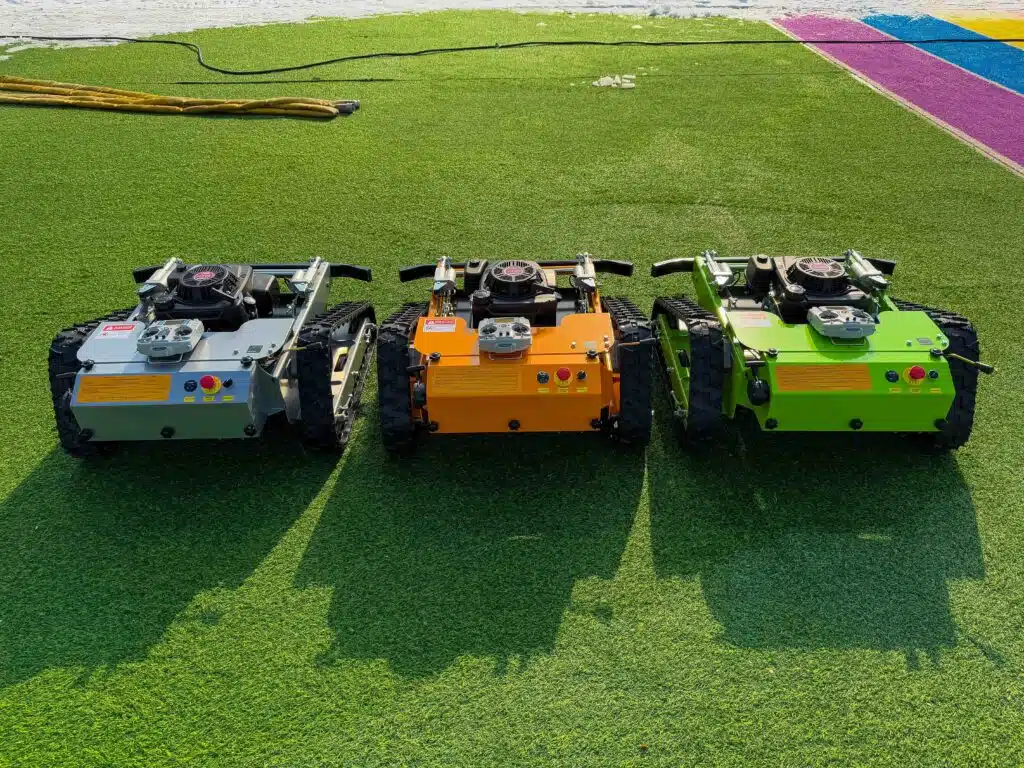
Mid-range ride-on mowers in Europe often have:
- Cutting width: about 67–107 cm
- Top speed: 8–13 km/h on flat ground
On a big flat lawn, a ride-on can easily reach 3,000–8,000 m²/h in ideal conditions, especially with a wide deck and confident operator.
But this speed drops when:
- There are many trees, flower beds or tight corners
- The lawn has slopes, banks, ditches or hidden holes
- The operator has to drive up-and-down only on slopes (safer than side-to-side)
So the real comparison looks different in different scenarios.
4.3 Flat Lawn vs Slope vs Rough Ground
Scenario A – Large, open, flat lawn (no steep slopes)
- Ride-on: Can usually operate near its ideal speed; one pass covers 70–110 cm.
- RC mower: Covers 50–80 cm and moves at roughly 3 km/h, which is slower.
Result:
On a clean football field or estate lawn, a ride-on is noticeably faster than a typical Chinese RC mower.
Scenario B – Mixed terrain with 20–40° slopes (banks, ditches, solar farms)
Here things change dramatically:
- Ride-on: Most manuals and safety agencies advise against mowing steep slopes and embankments with ride-ons because of rollover risk. Many specify maximum slopes in the 12–15° range.
- Operator has to slow down, take awkward lines, sometimes leave areas uncut or switch to string trimmers and manual work.
- RC mower: Tracks, low center of gravity and remote control allow consistent speed on slopes up to around 35–45°, depending on the model and ground conditions.
Result:
On sloped or risky terrain, the RC mower:
- Cuts areas a ride-on should not enter at all
- Avoids constant stopping and manual trimming
- Often finishes the whole job faster, even though its raw speed is lower, simply because it can mow the dangerous parts continuously.
Scenario C – Rough, overgrown, uneven ground
Think: orchards, roadside verges, abandoned plots, berry farms, olive groves:
- Ride-on: More issues with hidden obstacles, holes, rocks, stumps; high risk of sudden jolts or tip-overs; operator must go slowly and carefully.
- RC mower: Tracks and robust flail deck are designed to “eat” rough grass and shrubs up to a certain thickness; operator stands off to the side and can work more confidently.
Result:
In rough conditions, a good Chinese RC slope mower often matches or beats the effective speed of a ride-on, while exposing the operator to much less risk and fatigue.
5. Safety: Where Things Really Get Serious
5.1 Rollover & Run-over Risks with Ride-On Mowers
Multiple safety bodies report significant injury numbers from lawnmower accidents every year:
- Lawnmower injuries often involve lacerations, fractures and amputations; riding mowers tend to cause more severe injuries than walk-behind mowers.
- Safety agencies highlight that many fatal incidents involve ride-on mowers rolling over or running over someone, including children and bystanders.
- Regulators and manufacturers repeatedly warn about high rollover risk when ride-ons are used:
- On steep slopes or uneven ground
- Near water bodies, ditches and embankments
- At high speed or with sudden turns or stops
Some newer ride-ons use ROPS (rollover protection systems) and seat belts, but many residential or light commercial models do not. And even with ROPS, a rollover is still a serious event.
5.2 How RC Mowers Change the Safety Game
A remote-control mower changes two core things:
- The operator is not on the machine.
If the RC mower tips, slides or hits an obstacle, the operator is several meters away, not trapped underneath. - The machine itself is lower and more stable.
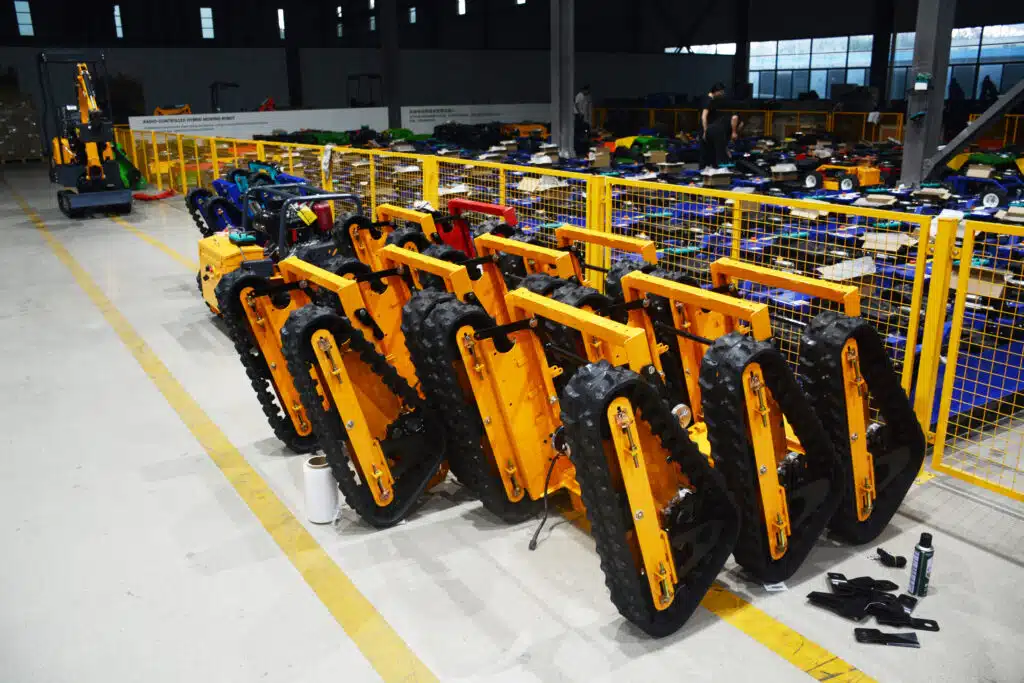
Tracked RC slope mowers sit very low to the ground with a wide stance. That greatly reduces rollover tendency compared with a tall ride-on carrying a human weight high above ground.
Other safety advantages of a decent Chinese RC mower:
- Remote emergency stop button on the controller
- Automatic engine shutdown or blade stop if it loses signal (on better models)
- Work on steeper slopes without putting the operator in the danger zone
This does not mean RC mowers are harmless. Blades are still blades, and a runaway machine is dangerous. But the type of risk shifts from “operator gets crushed in a rollover” to “machine must be prevented from hitting people/property.”
For landowners and contractors, that is often a much more manageable risk: set a clear exclusion zone, keep bystanders away, and stay behind the machine.
5.3 Key Safety Features to Demand from a Chinese Supplier
When considering a Chinese RC mower, especially for professional use, it is worth insisting on a few basics:
- Reliable emergency stop: Big, clear, red button on the remote that stops the blades and engine quickly.
- Fail-safe communication: The mower should stop or brake if it loses signal, not keep driving blindly.
- Physical guards: Solid blade deck and side guards to reduce the chance of stones and debris flying out.
- Engine & emissions certification: For Europe, look for CE and EURO 5 / Stage V; for the US, EPA. Many serious Chinese makers, including Nicosail, highlight these marks in their product listings.
- Clear slope rating & test data: Supplier should clearly state maximum safe slope (e.g., 35–45°) and not just claim “any slope.”
If a supplier is vague about these details or cannot provide test data and certificates, it is safer to look elsewhere.
6. Terrain & Applications: Who Should Use What?
Here is a simple way to match machine type to typical jobs.
RC Mower is usually the better choice for:
- Steep slopes and banks (roadside, riverbanks, dams, ditches)
- Solar farms with uneven ground and panel rows
- Orchards and vineyards on hillsides
- Rough, overgrown plots with tall grass and small shrubs
- Areas near water, ditches, culverts where a ride-on rollover would be catastrophic
In these areas, a ride-on is either too risky or too slow once the operator drives cautiously enough to stay safe. A tracked RC mower can stay low, keep traction, and let the operator stand well clear.
Ride-On Mower is usually the better choice for:
- Large, flat lawns and parks
- Golf fairways or sports fields with minimal slope
- Residential and estate lawns where comfort and speed on smooth grass matter
- Users who value sitting comfort and want a machine that feels like a small tractor
A ride-on gives higher commuting speed, bigger decks and more comfort for long, low-risk jobs.
7. Cost & Ownership: Machine Price, Labor, Fuel, Maintenance
7.1 Machine Price
Rough guide (as of 2024–2025):
- Chinese RC slope mowers from factories and trading platforms:
- Typically around US$1,000–3,000 depending on power and deck width
- Ride-on mowers in Europe:
- Entry-level ride-ons around £1,200–1,500 (about €1,400–1,700)
- Garden tractors and larger machines from £2,000 up to £5,000+ (around €2,300–6,000+).
So at first glance, cheaper Chinese RC mowers overlap with lower mid-range ride-ons, while heavy-duty RC flail mowers can approach prices of serious ride-ons.
7.2 Labor & Time Savings
On simple flat lawns, a ride-on’s higher speed and wider deck mean less time per job, especially in daily or weekly maintenance work.
On slopes and rough land, the picture flips:
- Without an RC mower, finishing dangerous areas might require:
- Very slow ride-on passes
- Re-mowing sections
- Extra manual work with brush cutters
- With an RC mower, the operator can often complete everything in one pass, from a safe distance.
For contractors or municipalities, this can mean:
- Fewer workers onsite
- Shorter road closures
- Less time spent trimming leftover areas
Even if the RC machine is slightly slower on pure flat ground, it can reduce total labor hours when slopes and difficult terrain are included.
7.3 Fuel & Maintenance
Both machine types are usually small gasoline engines, so:
- Fuel use is similar per unit of work, assuming similar engine size and load.
- Maintenance jobs are also familiar: oil change, air filter, belts, blades, greasing.
RC mowers add:
- Electronics and remote-control components that must be kept dry and protected
- Track systems (for crawler models), which require checking for wear and tension
Ride-ons add:
- More complex steering and transmission systems
- Seat, safety switches, and sometimes ROPS that also need inspection
Serious Chinese manufacturers like Nicosail typically offer clear spare-part lists and technical support, which is important if the machine will be used commercially or rebranded by distributors.
8. What to Look for When Buying a Chinese RC Lawn Mower
For many buyers, especially distributors or contractors, a “Chinese RC mower” could mean many different quality levels. Choosing the right one matters more than the country of origin.
8.1 Technical Points
Key specs to examine:
- Engine & power
- 7–16 hp is common; more power helps in thick brush.
- Ask for engine brand and emissions standard (EURO 5, EPA).
- Cutting width & type
- 500 mm: small, compact, better for tight orchards
- 800–1000 mm: faster for large areas
- Flail vs rotary:
- Flail better for rough brush and mixed vegetation
- Rotary deck better for lawns but less tolerant of thick woody material
- Slope capability
- Take advertised “45° slope” claims with caution; real safe slope also depends on ground conditions and grass moisture.
- Ask for tested slope data and, if possible, videos of real operation.
- Travel speed & mowing efficiency
- For example, some Nicosail machines quote 3–5 km/h speed and 1,000–3,000 m²/h mowing efficiency; this is a practical reference point for planning work.
- Remote-control range & responsiveness
- 100–200 m usable range is common.
- Look for proportional control (smooth speed/steering) rather than only on/off.
- Battery & electrics
- Check waterproofing and cable routing.
- Ask what happens in heavy rain – is the machine rated for wet conditions?
8.2 Supplier & Certification Checks (CE, EPA, EURO 5)
When dealing with any Chinese supplier, some basic due diligence helps avoid problems:
- Certification documents:
- CE declaration and test reports for the machine.
- Engine certificates for EPA / EURO 5 as needed.
- Export experience to your region:
- Suppliers with a history of exporting to Germany, Italy, US, Australia usually understand regulations and packaging requirements better.
- Production capacity & lead time:
- For example, Nicosail lists 300 units/month capacity for certain RC mowers, which helps distributors plan their season.
- Spare parts & warranty:
- Ask for a full spare-part list, including belts, blades, track assemblies, remote-control units.
- Clarify warranty period (1 year is commonly offered by Chinese manufacturers) and how claims are handled.
- Communication & documentation:
- Operating manual in English or target language.
- Exploded parts diagrams and wiring schematics.
8.3 Example: Nicosail Remote-Control Lawn Mowers
Factories like Nicosail in Shandong focus on exporting RC mowers and other compact machines to Europe, North America and Australia. Product listings show:
- Remote-control tracked mowers with:
- 500–800 mm cutting widths
- 7.5–16 hp engines
- 3–5 km/h travel speeds
- Mowing efficiency from around 1,000 to 3,000 m²/h
- 45° climbing ability in some models
- CE, EPA, EURO 5 emissions compliance and customization options for color and branding, which is useful for distributors.
Choosing a supplier with this level of detail and export experience makes it easier for both end users and rebranding distributors to avoid common pitfalls like certificate issues or spare-parts shortages later.
9. RC vs Ride-On: Simple Decision Checklist
Use the checklist below as a quick decision aid.
Choose a Chinese RC Lawn Mower if:
- More than 20–30% of the area is on slopes, banks or rough terrain
- There are ditches, ponds, embankments or roadside verges where rollovers are a real risk
- Labor costs are high and there is a need to reduce manual brush-cutting work
- The goal is to protect operators: older workers, seasonal staff, or anyone not comfortable on steep slopes
- There is interest in rebranding and reselling RC mowers from a Chinese factory with CE/EPA-compliant engines and stable supply (for example, Nicosail’s export-focused models)
Choose a Ride-On Mower if:
- Most of the work is flat or gently sloping lawns
- Comfort and high speed on open ground matter more than extreme slope capability
- There are many acres of safe, regular turf to cut every week
- A local dealer network is preferred for service and spare parts
For many professional users, the ideal setup is actually both:
- Ride-on for large, safe open areas
- Chinese RC slope mower as a specialist tool for embankments, solar farms, orchards and dangerous corners
This combination often gives the best total productivity and safety.
10. FAQs
Q1. Are Chinese RC lawn mowers really safe to use on very steep slopes?
Serious tracked RC mowers from established Chinese factories are designed for steep slopes up to around 35–45° and are commonly used in these conditions.
However, safe use still depends on ground condition, operator training and correct setup. Slippery wet grass, loose stones and hidden holes can reduce real-world safe slope far below the theoretical maximum. The operator should always keep distance, use the emergency stop if the machine starts sliding, and avoid working above cliffs, roads or water without barriers.
Q2. Do RC mowers cut as nicely as ride-on mowers on fine lawns?
Most Chinese RC mowers use flail or heavy-duty rotary decks, optimized for rough grass and weeds. Ride-on mowers aimed at lawns often give a cleaner, more even finish on short turf. For a manicured lawn, a ride-on or high-quality lawn tractor still has the edge in cut appearance. RC mowers shine where the priority is safety and clearing difficult terrain, not a golf-green finish.
Q3. What about maintenance and spare parts for Chinese RC mowers?
Mechanically, RC mowers are simple gasoline machines with blades, belts, filters and tracks. Any competent small-engine workshop can usually service them. The important part is access to the correct spare parts – especially belts, blades, tracks and electronic boards. Buyers should choose suppliers that:
- Provide a parts catalogue
- Keep core parts in stock
- Offer online or video support for troubleshooting
Export-focused manufacturers like Nicosail typically prepare these materials from the start because most of their machines go overseas.
Q4. Are ride-on mowers really that dangerous on slopes? Can’t they just go slower?
Going slowly helps, but the main issue is center of gravity and traction. Safety agencies and manufacturers repeatedly warn that ride-ons have a high risk of rollover on steep slopes, especially side-to-side across the slope.
Even at low speed, a sudden wheel slip, hole or soft edge can flip the machine. Without ROPS and seatbelt, the operator can be pinned underneath. This is exactly why many steep banks and roadsides are now cut with remote-control or robotic slope mowers instead.
Q5. How does cutting speed of a Chinese RC mower compare with a ride-on in real life?
On a big flat football field, a decent ride-on with a wide deck is simply faster – it can move at higher speed and cut more width in one pass.
On a mixed or risky site with slopes, ditches and obstacles, a Chinese RC mower often wins overall because:
- It can enter areas where a ride-on should not go at all
- It keeps a more constant working speed, without the operator slowing down for personal safety
- It can reduce or eliminate extra brush cutter work around banks and hard-to-reach edges
For many contractors, the question shifts from “which is faster per hour” to “which finishes the entire job in one safe operation.”
Q6. Is a Chinese RC mower suitable for private homeowners, or only for professionals?
That depends on the property. For a typical flat 1,000–2,000 m² garden, a ride-on or even a good walk-behind mower might be simpler and cheaper. For homeowners with:
- Large hilly properties
- Farm tracks, dams, ditches or ponds
- Orchards on slopes
a compact RC mower can be a very practical and much safer tool. Many Chinese models are now marketed directly to homeowners through international e-commerce platforms, with CE/EPA certification and user-friendly remotes.
Q7. Can RC mowers be rebranded and sold under another name?
Yes. Many Chinese manufacturers, including those behind brands like Nicosail, offer OEM/ODM services: custom color, logo, model name and even small technical adjustments.
This is useful for:
- Garden machinery distributors
- Rental companies with their own brand
- Importers building a local product line
In these cases, it is important to lock in technical specs, test machines in local conditions, and agree on branding and documentation before ordering larger batches.
11. Final Summary
- On pure flat lawns, a ride-on mower is usually faster and more comfortable.
- On slopes, rough ground, banks and dangerous edges, a Chinese RC tracked lawn mower is usually safer and often more efficient overall because it can go where a ride-on should not.
- Ride-ons carry significant rollover and run-over risks, especially on steep or uneven terrain, which is well documented by safety agencies worldwide.
- Modern Chinese RC mowers – especially those from export-focused factories like Nicosail – now offer solid engines, CE/EPA/EURO 5 compliance, 45° slope capability and 500–800 mm decks, at prices that often compete directly with mid-range ride-ons.
For landowners and contractors, the smartest strategy is not “RC or ride-on forever” but:
Use a ride-on where it is safe and fast, and a Chinese RC slope mower where it keeps people off dangerous ground.
With the right supplier, clear requirements, and proper training, a Chinese RC lawn mower can become one of the most productive and safety-improving tools on any property that has slopes, banks or tricky corners.