
1) What an RC lawn mower is (and why lawn care companies buy them)
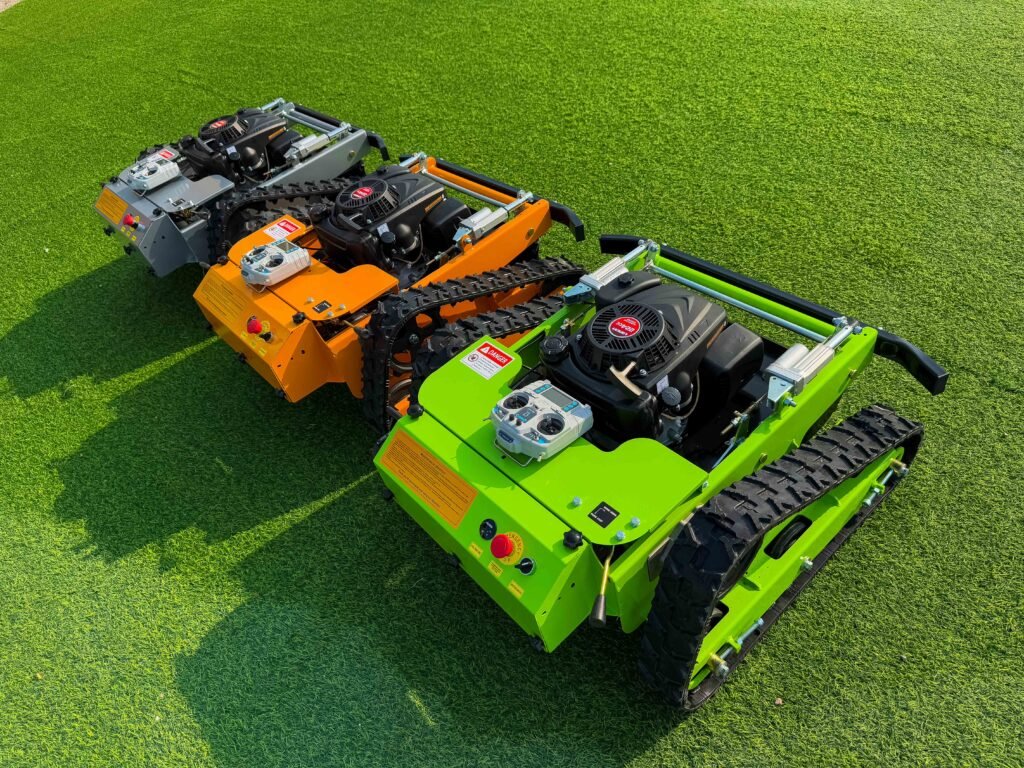
An RC (remote-controlled) lawn mower is basically a compact mowing machine (often tracked) that one operator controls from a safe distance. These machines are popular for:
- Steep slopes (roadside banks, ditches, retention ponds)
- Rough or risky areas (solar farms, orchards, brushy edges, wet ground)
- Labor shortages (one operator covers more “unfriendly” terrain)
For a lawn care business, the main reason is simple: more billable jobs with less risk—especially where walk-behind mowers or tractors feel unsafe.
2) Start with the jobs: terrain, grass type, and daily output
Before looking at brands or price, lock down three job facts:
H3: A) Terrain and obstacles
- Flat residential lawns? RC might be overkill.
- Slopes, uneven ground, holes, stones, hidden debris? RC starts to pay back fast.
H3: B) Vegetation type
- Soft turf / regular lawn → rotary deck can be efficient.
- Mixed weeds / thick grass / light brush → flail head usually wins.
- Unknown “wild” areas → flail is safer for impact and gives a cleaner finish.
H3: C) Output target (how many hours/day)
A practical way to think:
- If the plan is 2–3 hours/day on occasional slopes, a simpler machine can work.
- If the plan is 6–8 hours/day, the business is buying a production tool, not a gadget—parts quality, cooling, and service support become more important than the last 5% discount.
3) Track vs wheel: which one actually makes money
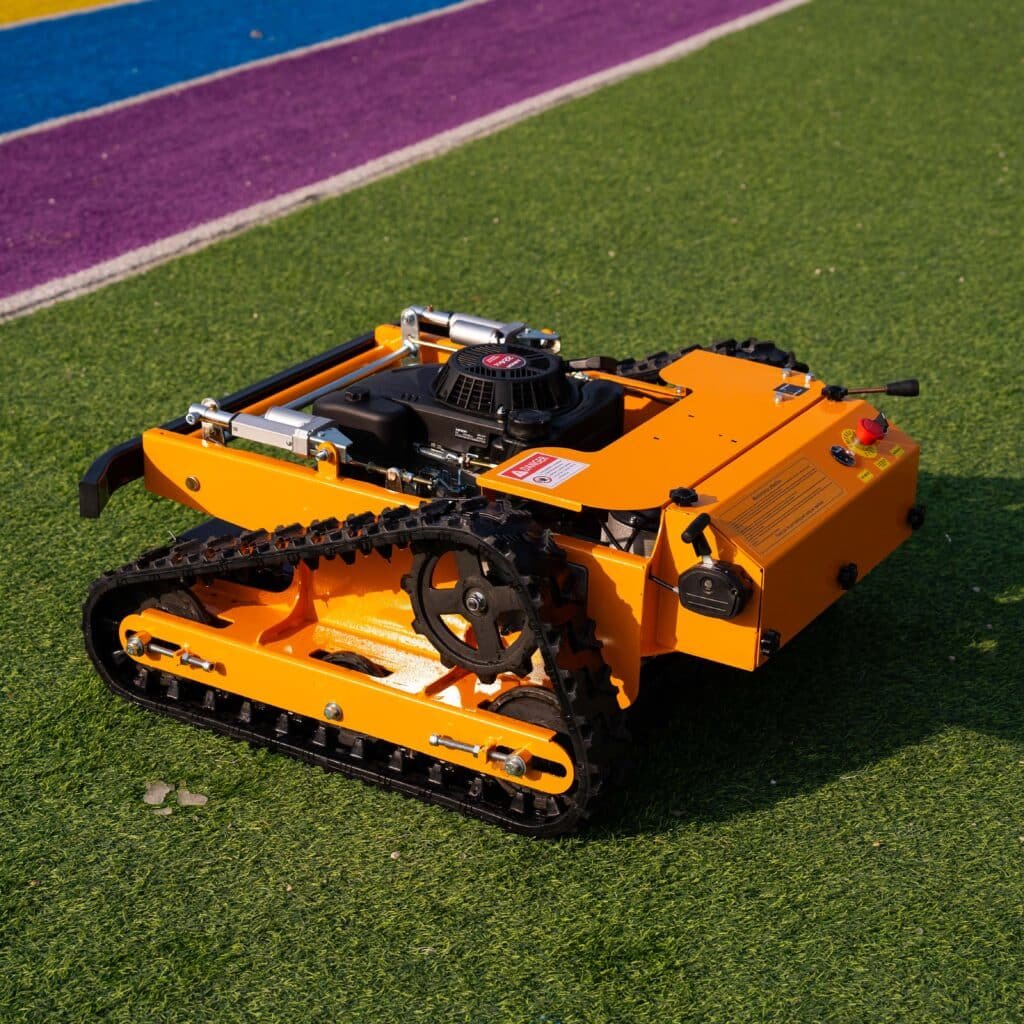
H3: Tracked RC mowers (most common)
Pros
- Better traction on slopes and wet ground
- Lower ground pressure (less sinking)
- More stable on uneven terrain
Cons
- Track system adds wear parts (rollers, tensioners, sprockets)
- Cheap tracks wear fast if compound and reinforcement are weak
Best for: roadside, embankments, solar farms, orchards, rough land.
H3: Wheeled RC mowers
Pros
- Often cheaper and simpler
- Less track maintenance
Cons
- Traction limits show up quickly on slopes or wet grass
- Can slide earlier than expected
Best for: mild slopes, relatively clean grass, lighter commercial work.
Business takeaway: if slope work is part of the core service, tracked usually protects margins because it avoids getting stuck, sliding, or refusing jobs.

4) Cutting systems: flail vs rotary vs mulching deck
This choice affects finish quality, impact resistance, and maintenance.
H3: Flail mower head (hammer or Y-blades)
Why contractors like it
- Handles mixed growth better (weeds, thick grass, light brush)
- More forgiving when hitting small debris
- Usually leaves a more uniform “managed” look in wild areas
Watch-outs
- More moving parts (bearings, belt/drive system)
- Needs proper rotor balance and strong housing
H3: Rotary deck (single/dual blade)
Why it works
- Efficient on lawn-like grass
- Often simpler and lighter
Watch-outs
- Hard impacts can bend spindles or damage the deck
- Can throw debris farther if guarding is weak
H3: Mulching deck
Good for lawn finish, but can struggle in tall, wet growth unless power is adequate.
Simple rule:
If customers include municipalities, farms, solar sites, and “overgrown cleanups,” flail is the safer default.
5) Power choice: gasoline, diesel, hybrid, or full electric
H3: Gasoline
- Lower upfront cost
- Easier to service in some regions
- Often enough for light-medium work
H3: Diesel
- Better torque and fuel economy in heavy duty cycles
- Typically longer engine life if maintained
- Often paired with more robust chassis
H3: Hybrid (engine + generator + electric drive)
- Very strong control at low speed
- Can reduce some hydraulic complexity depending on design
- Often smoother for remote work
H3: Full electric (battery)
- Quiet, low daily energy cost
- Great for noise-sensitive areas
- But runtime and battery replacement cost must be priced into the business
Contractor reality check:
If the machine must run “all day,” focus less on the brochure and more on:
- cooling capacity
- continuous duty rating
- real runtime under load
- ease of swapping battery/fuel refills on site
6) Slope numbers: how to read them without getting tricked
This is where marketing gets “creative.”
H3: Degrees vs percent
- 45° is about 100% slope (very steep).
- Some sellers list the biggest number they can print, measured in ideal conditions.
H3: Ask what the slope rating really means
A legitimate slope claim should be tied to:
- surface type (dry grass? wet grass? gravel?)
- mower orientation (up/down vs sideways traverse)
- cutting head installed or not
- fuel level / center of gravity changes
- operator distance / safety rule
Practical buying tip:
Treat extreme slope claims as “possible under ideal demo conditions.” For real contracting work, choose a model that feels overqualified by one level.
7) Remote control & safety: the features that prevent accidents
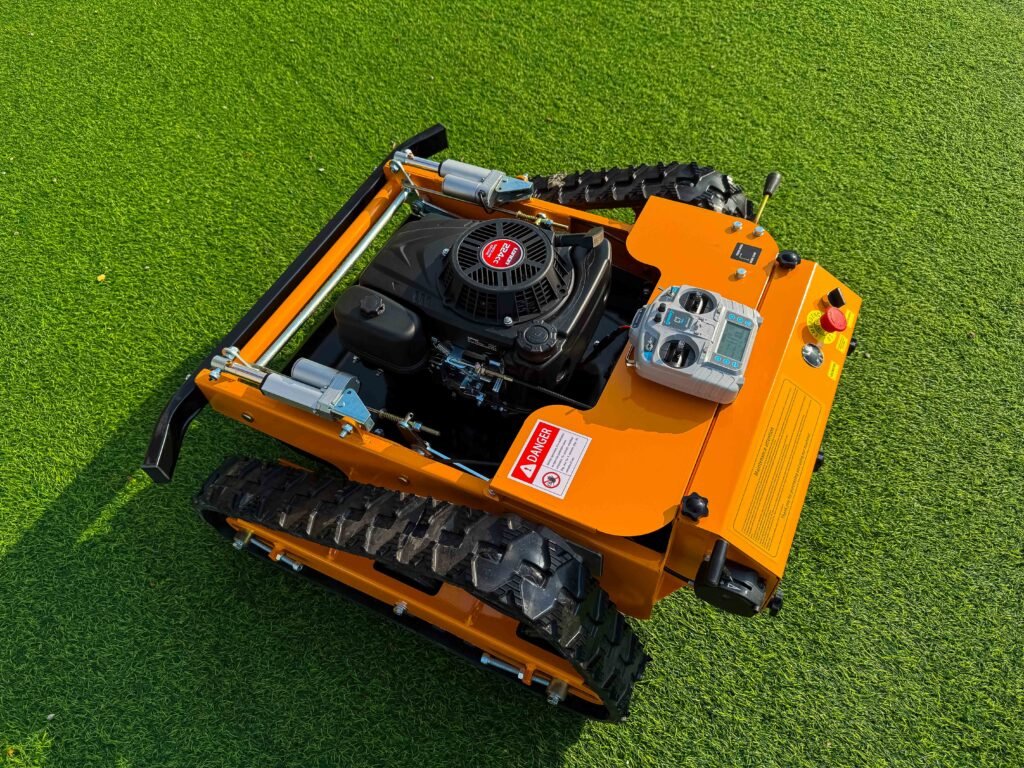
RC mowing is safer than putting an operator on a slope—only if safety systems are real.
H3: Must-have control features
- Emergency stop on remote + on machine
- Fail-safe stop if signal is lost
- Clear indicators: battery/fuel, temperature, alarms
- Reasonable control range for the jobsite layout
H3: Must-have safety hardware
- Solid guarding around cutting system
- Anti-slip track design and stable chassis
- Tilt/angle monitoring (common on better units)
- Fire protection mindset: shielding, routing, clamps, fuses
H3: Compliance reminder for EU importers
Because the machine uses radio control, radio compliance can matter in addition to machinery safety. In the EU, the Radio Equipment Directive (RED) 2014/53/EU is the main framework for radio equipment placed on the market.
Separately, machinery placed on the EU market is moving from the Machinery Directive to the Machinery Regulation (EU) 2023/1230, which applies from 20 January 2027.
(That doesn’t mean every mower suddenly becomes “illegal” tomorrow—it means importers should plan documentation and testing the right way for the target market.)
8) Reliability you can’t see: welding, hydraulics, wiring, and bearings
A lawn care business doesn’t lose money when the mower is cutting. It loses money when:
- the machine is down
- the team waits for parts
- a small leak becomes a big failure mid-season
Here’s what “invisible reliability” looks like in real factory practice.
H3: Frame and welding
A good RC mower chassis typically shows:
- consistent weld beads (not patchy or porous)
- gussets in stress corners
- straight alignment so tracks run true
Easy check during video inspection:
Ask the supplier to slowly pan across the underside and the track mounts. If the camera “avoids” these areas, that’s a signal.
H3: Hydraulics and fittings (if hydraulic drive is used)
Common failure points are not the pump itself—it’s:
- cheap hoses with weak crimping
- poor routing (rubbing = future leak)
- low-quality quick couplers and fittings
H3: Wiring harness discipline
A reliable machine has:
- protected routing away from heat and moving parts
- sealed connectors where needed
- correct fuse layout and labeling
This sounds small, but for contractors it’s big: electrical issues are time killers because they’re hard to diagnose on a jobsite.
H3: Bearings and rotor balance (especially for flail)
A flail head is only “smooth” if:
- rotor is balanced well
- bearings are correctly selected
- dust and debris sealing is decent
If the supplier can’t explain bearing selection or sealing approach in plain language, it often means the design is copied and cost-cut.
9) Parts, service, and downtime: the real cost driver
Many buyers focus on purchase price and forget the math of downtime.
H3: What to confirm before paying a deposit
- Spare parts list with photos and part numbers
- Standard lead time for wear parts (belts, blades, flail hammers, tracks, rollers)
- Warranty scope: what’s covered, what’s not, how claims are handled
- Whether the supplier supports video troubleshooting with an engineer
H3: Smart spare kit for the first season
For most commercial users, a first-shipment spares kit usually includes:
- belts / tensioner items
- a full set of flail knives or blades
- key bearings
- filters, fuses, relays
- one or two “easy to break” sensors/switches
This costs a little upfront and often saves the season.
10) Certifications & compliance (EU/NA/AU): what importers must verify
This section is written for buyers who import, distribute, or rebrand.
H3: EU
- Machinery compliance is tied to the legal framework; the Machinery Regulation (EU) 2023/1230 becomes applicable 20 January 2027.
- Because it’s remote-controlled, the radio side can fall under RED 2014/53/EU.
H3: North America (general safety standard awareness)
In the US, mower safety standards are often referenced through ANSI/OPEI documents (varies by mower category). For example, ANSI/OPEI 5395 series covers safety requirements/test methods for certain mower types.
For commercial turf equipment, ANSI/OPEI B71.4 is commonly cited as a commercial safety specification.
Important: compliance is not a sticker—it’s documentation + testing + correct configuration for the market.
11) Picking the right supplier: factory audit questions + red flags
Buying China-made equipment can be a big advantage—if the supplier is a real manufacturer with systems.
H3: Ask these 12 questions (simple, revealing)
- Is the supplier a factory or a trading company? Can they show the production lines?
- What percentage of parts are made in-house vs outsourced?
- How is track alignment checked before shipping?
- How is the cutting rotor tested for vibration?
- What is the pre-delivery inspection checklist (send a sample)?
- Can the supplier provide serial-number tracking for key components?
- How are warranty claims handled—parts shipped first or endless “proof” requests?
- What spares are stocked year-round?
- Can they show packaging method for export (steel frame, crate, tie-down points)?
- Can they provide a real test video: cold start, full throttle, cutting in load, emergency stop?
- Can they provide compliance documents matched to the exact model/configuration?
- Who provides after-sales support—salesperson only, or an engineer team?
H3: Red flags (common pain points)
- “Certificate” files with mismatched company names or model numbers
- Refusal to show serial plate rules
- No parts catalog
- No real QC checklist—only marketing slides
- Unrealistic lead times right before peak season
H3: Where “Nicosail” fits
For buyers who also handle landscaping equipment beyond mowing, it’s common to source from factories that run repeatable QC and export support. Nicosail is known in compact construction machinery (mini excavators, compact tracked loaders, skid steer loaders) with a factory setup designed for export markets and customization—exactly the kind of supplier behavior that RC mower buyers should look for: stable production, clear documentation, and practical spare parts planning. (Even if the product category differs, the supplier vetting logic is the same.)
12) Logistics, packaging, and spares: how to land the machine safely
H3: Packaging matters more than most people think
RC mowers often arrive with:
- bent guards
- cracked plastic covers
- loose connectors
…because packaging was designed for domestic shipping, not container shocks.
Ask for:
- steel-frame base inside the crate
- moisture protection and corrosion prevention
- photo record of tie-down points
- spare paint + touch-up plan if branding matters
H3: Shipping plan that avoids peak-season disasters
- Confirm production completion date in writing
- Require a pre-shipment inspection (even simple video + checklist)
- Keep spare parts in the same container if possible
- If rebranding, confirm lead time for decals/paint without delaying delivery
13) Quick selection cheat sheet (by business type)
H3: If the business mainly does steep banks / roadside
- tracked chassis
- flail head preferred
- strong safety controls (fail-safe stop, e-stop)
- order a full wear-parts kit up front
H3: If the business does mixed commercial lawns + occasional slopes
- mid-power tracked or heavy-duty wheeled model
- rotary or mulching deck depending on finish expectations
- prioritize quick maintenance access
H3: If the business serves farms / orchards / solar sites
- flail head for mixed growth
- dust protection mindset (filters, seals, harness routing)
- supplier must prove parts availability during season
FAQs
Q1: What cutting width is best for a lawn care business?
Most contractors pick a width that matches the transport plan and gate access. Wider cuts faster, but only if it fits the trailer, jobsite paths, and doesn’t sacrifice stability on slopes.
Q2: Flail or rotary—what’s better for making money?
For predictable lawn grass, rotary can be efficient. For “unknown” sites—tall grass, weeds, light brush—flail is usually the safer, more flexible choice.
Q3: How far should the remote control range be?
Enough to keep the operator out of danger while staying in clear line-of-sight on typical sites. More range is not always better if the machine can be operated unsafely from too far away.
Q4: Are slope ratings trustworthy?
They can be, but only if the supplier explains test conditions. The safer approach is buying one class above the minimum needed, because real sites include wet grass, loose soil, and hidden holes.
Q5: What should be included in a first-season spare parts kit?
Belts, blades/knives, key bearings, filters, fuses/relays, and a few common sensors/switches. This prevents small issues from stopping jobs.
Q6: What documents should an importer request from a China supplier?
Model-matched compliance paperwork, serial-number rules, inspection checklist, parts catalog, and clear warranty process. For the EU, radio compliance can be relevant because RC systems fall under RED frameworks.
Q7: How can certificate fraud be avoided?
Match the certificate to the exact model number, manufacturer name, and configuration. Verify consistency across documents, labels, and serial plates. Avoid suppliers who refuse transparent paperwork.
Q8: Is it better to buy from a factory or a trading company?
Factories usually control QC and parts supply better. Trading companies can work if they prove after-sales capability and provide clear accountability, but the risk is higher.
Summary
Choosing the right China-made RC lawn mower is less about chasing the lowest quote and more about matching the machine to real job conditions: terrain, cutting system, power type, and slope reality. The winning buyers are the ones who treat RC mowers like production equipment—checking safety systems, invisible reliability (welds, wiring, bearings), parts readiness, and supplier discipline before paying deposits. Importers should also plan documentation correctly for their market, including machinery and (where applicable) radio compliance frameworks in the EU.
For businesses that source multiple landscaping and sitework machines, working with export-ready manufacturers that run consistent QC and practical after-sales—such as factories in the same reliability mindset as Nicosail—helps reduce downtime and protect peak-season revenue, without turning procurement into a gamble.


