
1. Why Remote-Controlled Lawn Mowers Are Exploding in 2026
In 2026, remote-controlled lawn mowers are no longer “special machines.” They are tools people actively look for when mowing becomes dangerous, tiring, or too expensive with labor.
Three reasons explain the boom:
First, labor cost keeps rising.
In Europe, North America, and Australia, mowing slopes or large areas requires trained workers. That cost keeps going up every year.
Second, safety requirements are stricter.
Steep slopes, roadside mowing, solar farms, and riverbanks are risky. Remote-controlled machines remove the operator from danger.
Third, Chinese factories have matured.
Ten years ago, Chinese remote mowers were “cheap but rough.” In 2026, many factories now supply Europe-level welding, motors, and electronics—at a much better price.
That’s why buyers are no longer asking “Can China make this?”
They’re asking “Which Chinese factory makes it right?”

2. Who Should Buy a Remote-Controlled Lawn Mower (And Who Shouldn’t)
Good Fit:
- Landscaping companies handling slopes and rough terrain
- Municipal contractors (roadsides, embankments, parks)
- Solar farm and wind farm maintenance teams
- Farm owners with hills, ditches, or orchards
- Equipment distributors looking for high-margin niche machines
Not a Good Fit:
- Small flat lawns under 1,000 m²
- Home users expecting a “robot vacuum-style” mower
- Buyers who don’t want any maintenance at all
A remote-controlled mower is a machine, not a toy.
It replaces manpower, not gardening scissors.
3. Main Types of Chinese Remote-Controlled Lawn Mowers
3.1 Tracked Remote-Controlled Lawn Mowers
Best for: slopes, wet ground, loose soil
Tracked models dominate the export market in 2026.
Why?
- Better grip on 30–45° slopes
- Lower ground pressure
- More stable when cutting thick grass
Factory feedback shows tracked machines account for over 65% of export orders.
Trade-off:
Tracks cost more and require tension adjustment, but buyers accept this for safety.
3.2 Wheeled Remote-Controlled Lawn Mowers
Best for: flat or semi-flat land, large open fields
Wheeled models are:
- Lighter
- Faster
- Easier to maintain
However, once slopes exceed 20°, wheels start losing traction.
That’s why wheeled models are mostly used in parks, farms, and sports fields.
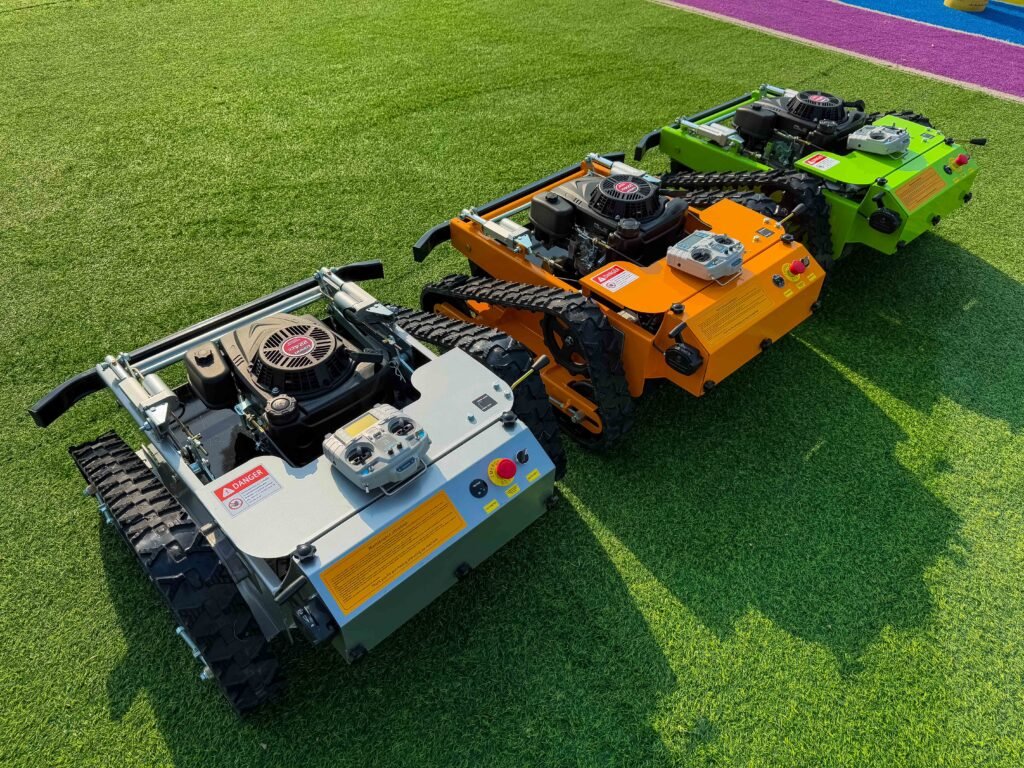
3.3 Hybrid / Heavy-Duty Brush Cutters
These machines are closer to remote-controlled mini bulldozers with blades.
They handle:
- Tall weeds
- Bushes
- Light shrubs
Usually equipped with:
- Hammer blades or flail systems
- Stronger motors
- Reinforced chassis
They cost more but replace multiple workers with brush cutters.
4. Key Specs That Really Matter (No Marketing Talk)
Forget fancy brochures. Focus on these:
4.1 Motor Type
- Gasoline engines: powerful, easy refueling, louder
- Diesel engines: torque-heavy, fuel-efficient, heavier
- Electric (battery): quiet, low maintenance, limited runtime
In 2026, gasoline still dominates exports, especially for slope mowing.
4.2 Remote Control System
What matters is signal stability, not screen size.
Good systems have:
- 100–200 m effective range
- Anti-interference design
- Emergency stop (E-stop)
Cheap systems look modern but lose signal near trees or slopes.
4.3 Cutting Width
Typical ranges:
- 600–800 mm: narrow, precise areas
- 800–1,000 mm: best balance
- 1,000+ mm: high efficiency, needs power
Factories often exaggerate cutting width. Always confirm actual blade width, not housing size.
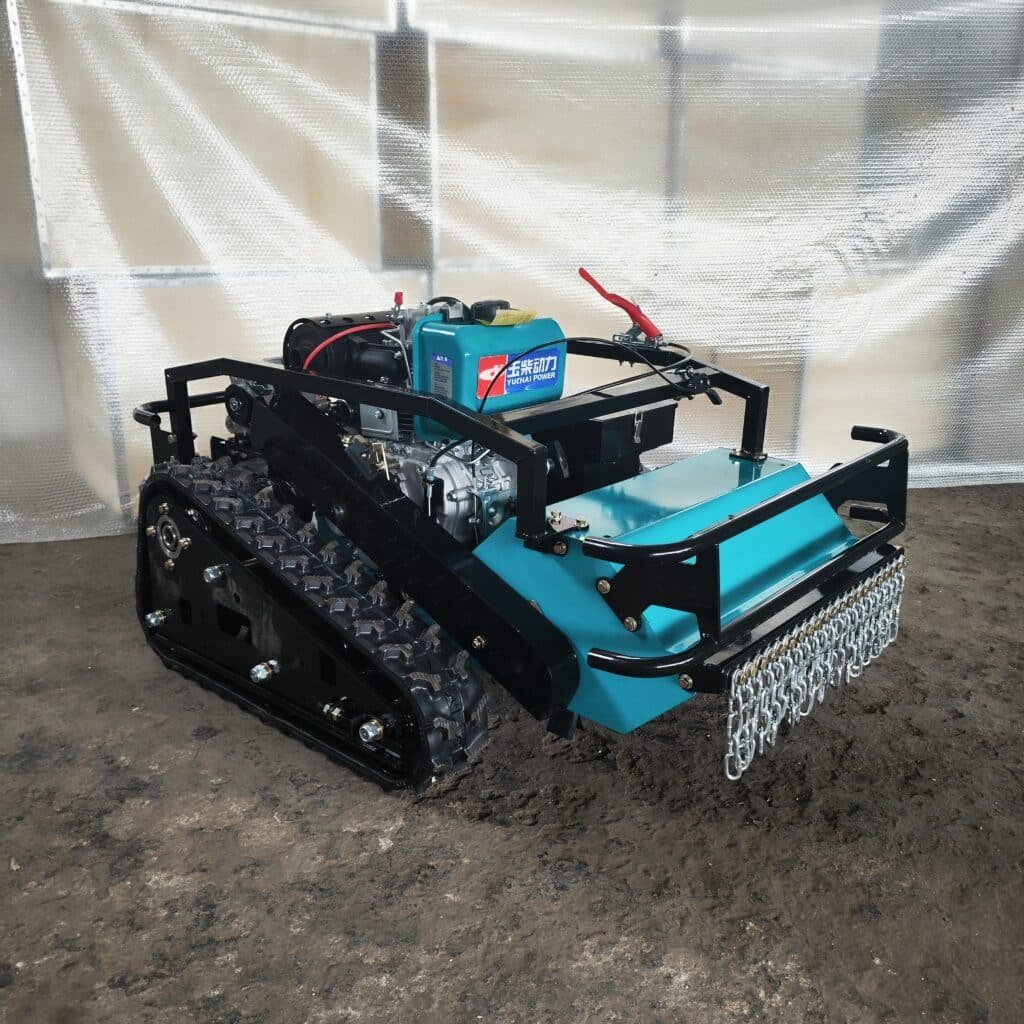
4.4 Slope Rating
Real slope performance is 10–15° lower than claimed numbers.
If a supplier says “45°,” assume safe working at 30°–35°.
Honest factories will say this upfront.
5. Best Chinese Remote-Controlled Lawn Mower Picks in 2026
Instead of brand hype, this section focuses on configurations that sell best.
Pick 1: Tracked Gasoline RC Mower (800–1000 mm)
Why it sells:
- Strong demand in Europe
- Balanced price and performance
- Easy parts sourcing
Typical buyers: distributors, municipalities
Pick 2: Heavy-Duty RC Brush Cutter
Why it sells:
- Replaces multiple workers
- Ideal for rough terrain
- High resale value
Typical buyers: contractors, rental companies
Pick 3: Compact Electric RC Mower
Why it sells:
- Noise-sensitive areas
- Indoor or near-residential zones
Limitation: runtime still limits large-scale use.
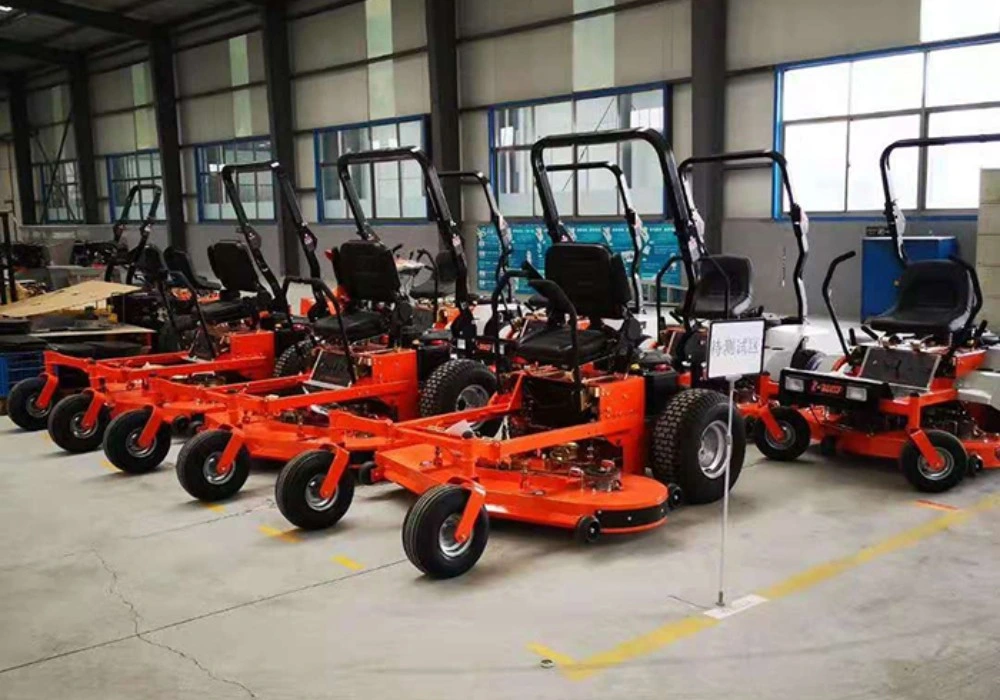
Factories like Nicosail focus on export-stable configurations instead of dozens of unreliable models. That’s why distributors prefer fewer SKUs that actually work in the field.
6. Price Breakdown: What You Really Pay in 2026
Factory EXW Prices (China):
- Wheeled RC mower: USD 2,000–3,000
- Tracked RC mower: USD 3,000–5,000
- Heavy-duty brush cutter: USD 5,000–8,000
Export Reality (Landed Cost):
Add:
- Crating
- Sea freight
- Import duty
- Local compliance
Final landed cost is usually 25–40% higher than EXW.
If a price looks too low, something is missing—usually steel thickness, motor quality, or electronics.
7. Common Buying Concerns (Quality, Safety, Certification)
“Will it break after one season?”
Failures usually come from:
- Thin frames
- Cheap bearings
- Weak track systems
Ask for internal structure photos, not just finished machines.
“Are certificates real?”
Some suppliers reuse old or unrelated certificates.
Real factories:
- Provide matching model numbers
- Allow third-party inspection
- Don’t rush paperwork
“Is maintenance complicated?”
A good RC mower should:
- Use common belts
- Standard bearings
- Easily accessible blades
If maintenance requires special tools, walk away.
8. How to Avoid Bad Suppliers and Fake Specs
Red flags:
- Too many models, no focus
- No factory visit (video or live)
- Unreal slope claims
- Refusal to show testing videos
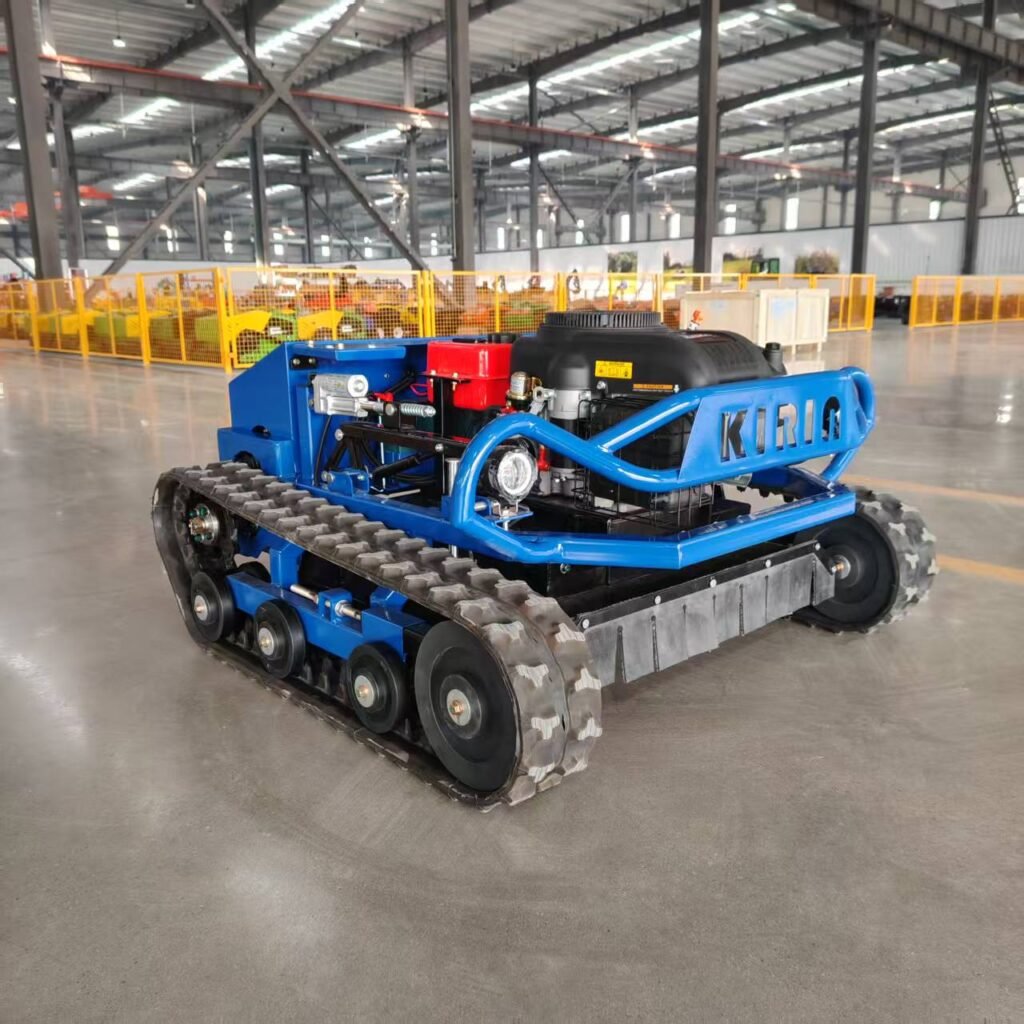
Reliable factories show:
- Welding lines
- Assembly process
- Test fields
This transparency is why brands like Nicosail gain trust quietly, without aggressive advertising.
9. Why More Buyers Are Choosing Brands Like Nicosail
Not because of slogans.
Because:
- Stable production lines
- Fewer but proven models
- Export experience with Europe and North America
- Willingness to customize branding without changing core structure
For distributors, consistency matters more than innovation gimmicks.
10. FAQ
Q1: Can one operator control multiple machines?
In practice, no. Safety rules usually limit one operator per machine.
Q2: How long does shipping take?
Production: 25–40 days
Sea shipping: 30–45 days
Q3: Are spare parts easy to get?
For mainstream Chinese factories, yes—if standard components are used.
Q4: Can the mower work in rain?
Light rain, yes. Heavy rain and mud shorten lifespan.
Q5: Is OEM branding possible?
Yes. Most Chinese factories support OEM once volume is stable.
11. Final Summary
In 2026, Chinese remote-controlled lawn mowers are no longer “cheap alternatives.” They are practical, proven tools for dangerous and labor-heavy mowing jobs.
The smart buyers:
- Focus on structure, not looks
- Test slope performance honestly
- Choose factories with stable export experience
When selected correctly, a remote-controlled mower pays for itself faster than most people expect—and avoids injuries, labor headaches, and downtime.
That’s why this category keeps growing, quietly but steadily.


