
1) Why slope + obstacle mowing goes wrong so fast
Remote-controlled lawn mowers feel “safer” because the operator can stand away from the blades. That’s true—up to the moment traction breaks, the machine slides, or a wheel drops into a hole you didn’t see. On slopes, things happen in half a second:
- A small bump shifts weight downhill
- Tracks or tires lose bite on wet grass
- The mower “crabs” sideways
- The operator over-corrects with a big joystick input
- The machine meets an obstacle (stump/rock/fence post) at an angle
- Suddenly it pivots, climbs, tips, or slides into the hazard
So the real safety game is planning + gentle control + staying out of the danger zone, not just “standing far away.”
2) Know what kind of “remote-controlled mower” is actually being used
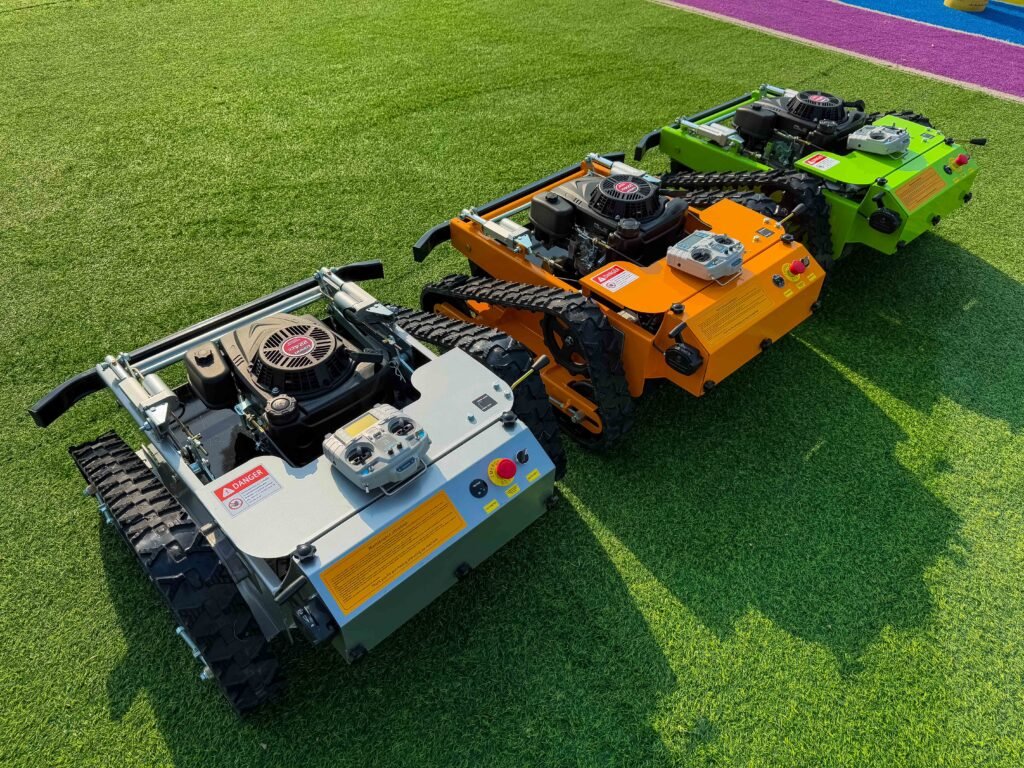
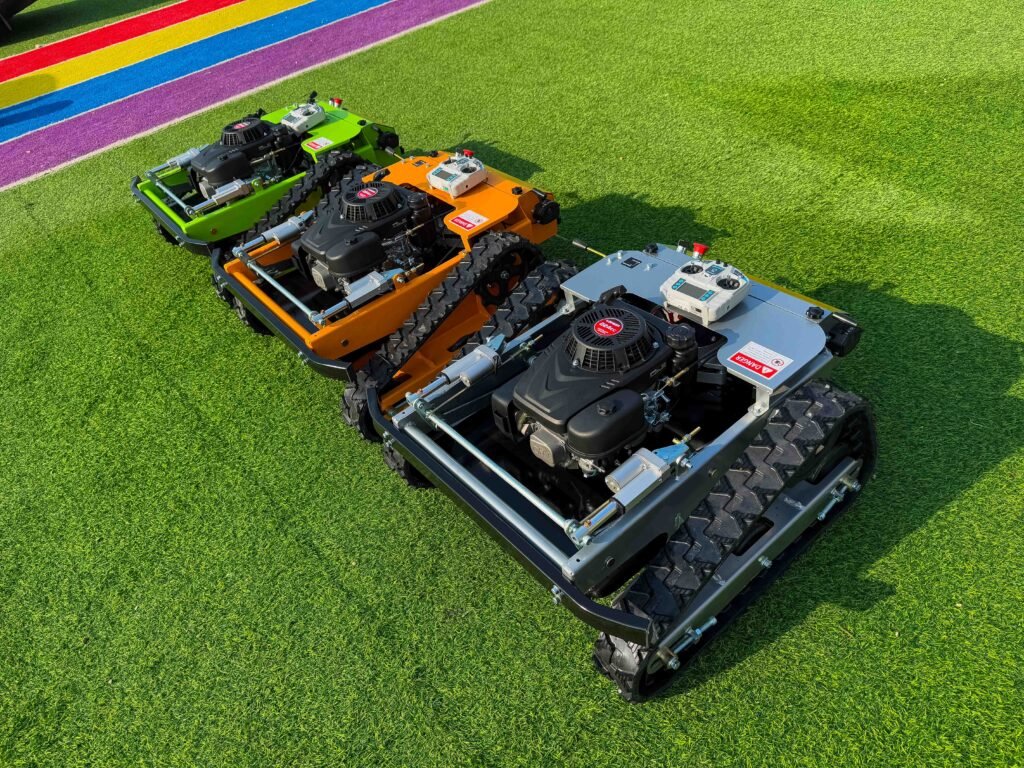
Chinese remote-controlled mowers cover a wide range. Safety steps change depending on what’s under you:
Common types
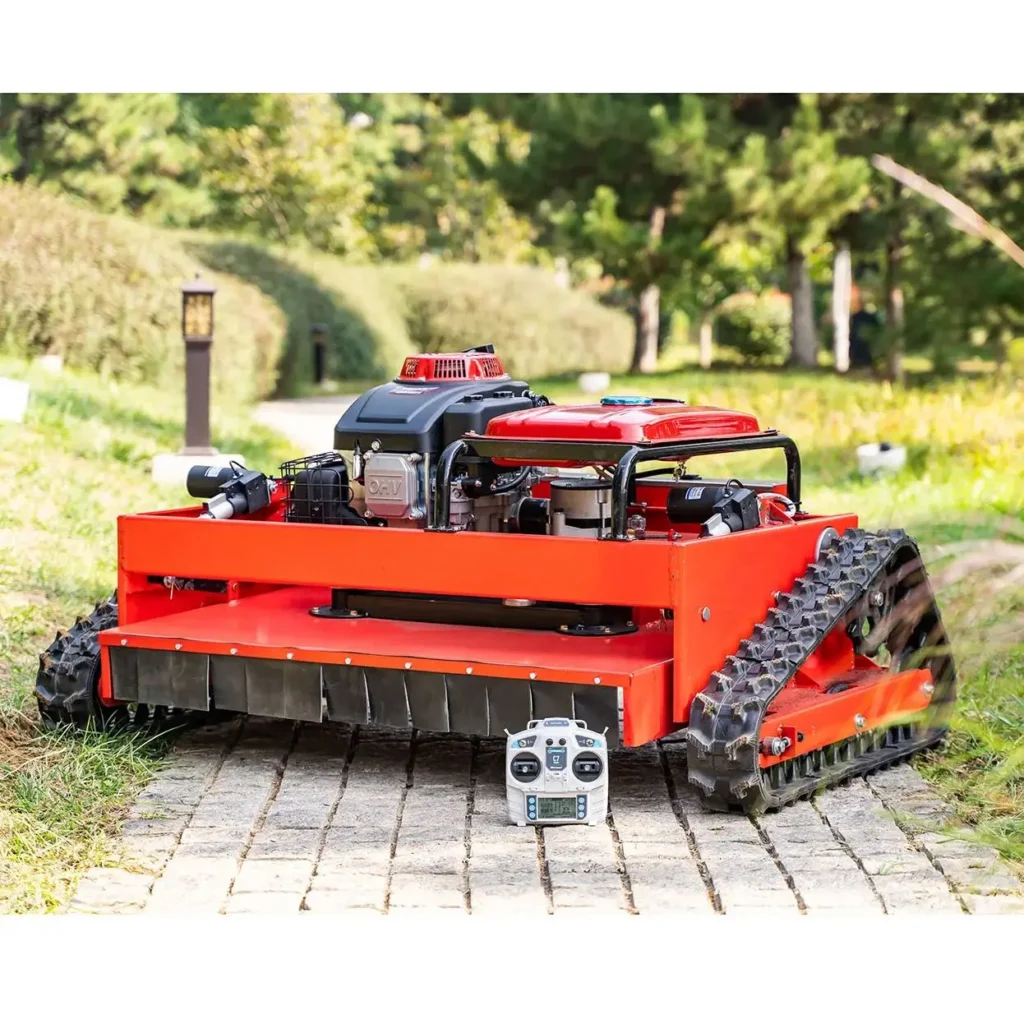
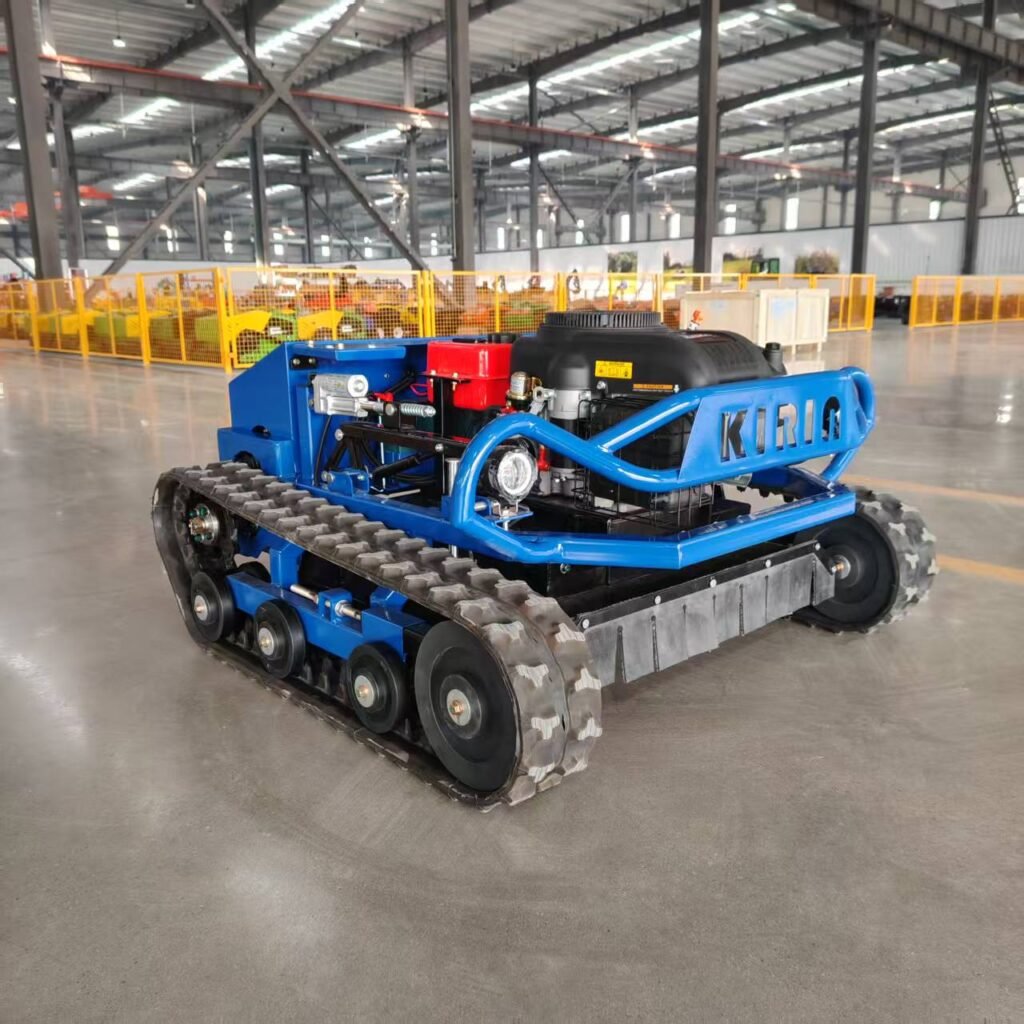
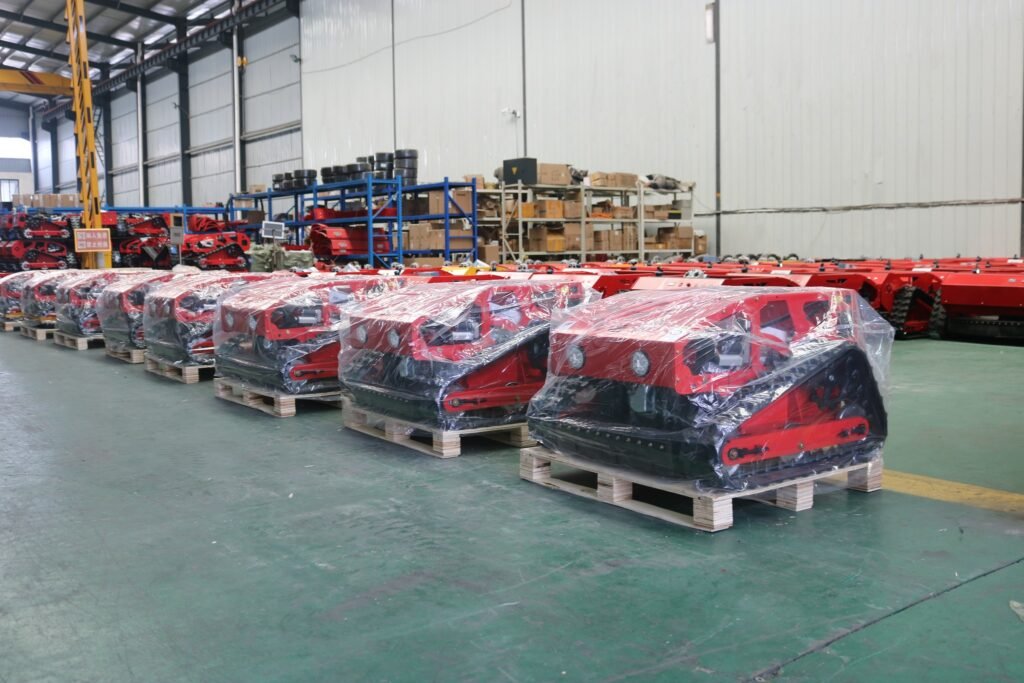
- Tracked RC mowers (rubber tracks): Usually best traction on slopes, but can still slide on wet grass and can “trip” on hidden obstacles.
- Wheeled RC mowers: Easier on flat ground, but slope traction depends heavily on tires and surface conditions.
- Flail/hammer mowers: Great for brush and rough ground, but they can throw debris farther—obstacle distance rules matter more.
- Rotary blade decks: Clean cut, but often more sensitive to hitting rocks/stumps.
Why this matters
A “slope mower” is not automatically safe on slopes. Two machines can look similar and behave totally different because of:
- Center of gravity
- Track/tire design
- Deck position and weight
- Power delivery and braking behavior
- Emergency stop response
- Remote signal reliability and failsafe settings
3) The #1 rule: follow the machine’s rated slope—then subtract a safety margin
Every machine should state a maximum slope rating in the manual/spec plate. That number is the starting point, not the finish line.
Practical rule:
- If the manual says X° or X%, treat it as “dry grass, smooth ground, perfect condition.”
- In real life, subtract a safety margin—especially if the site is uneven, wet, or full of obstacles.
Also: degrees vs percent is a common trap
- Degrees (°) and percent (%) are not the same.
- Many accidents happen when someone thinks “30%” means “30°.” It doesn’t.
If the machine only gives one unit, use a slope meter app, a simple inclinometer, or a physical slope gauge. Guessing with your eyes is how people get hurt.
4) Before-start checklist (takes 3 minutes, saves 3 months)
This is the boring part that prevents the exciting emergencies.
Walk the site first (yes, walk it)
- Pick up rocks, wire, branches, scrap metal, glass
- Mark holes, soft spots, hidden ditches
- Identify drop-offs and edges (ponds, culverts, retaining walls)
- Decide a safe “exit route” if the mower starts sliding
Machine quick checks
- Emergency stop works (remote + machine button)
- Remote battery is strong; mower battery/fuel adequate
- Tracks/tire condition: no missing lugs, no obvious damage
- Track tension (tracked models): too loose can derail; too tight stresses components
- Brakes / parking hold (if equipped)
- Deck/knife/flail condition: no loose hardware
- Guards and deflectors installed and not cracked
- No hydraulic leaks / fuel leaks (leaks are not just messy—they become fire and slip hazards)
The “small” check that matters most
- Confirm the machine is set to the correct speed mode (low/creep for slopes and obstacles).
5) Safe body position and “operator zone”
Remote control does not mean “stand anywhere.”
Safe operator zone
- Stand uphill and offset, not directly downhill or directly behind
- Keep a clear view of the mower AND the ground ahead
- Maintain distance so debris can’t reach you (more on that below)
Never stand here
- Directly downhill of the mower (slide path)
- On the fall line below a drop-off
- Between the mower and a solid obstacle (tree, wall, fence)
- Close to the discharge side on brush/rocky terrain
Simple mindset: the mower should never be able to reach the operator in one straight slide.
6) Slope basics: traction, weight shift, and rollover triggers
Even tracked mowers can fail on slopes. Here’s why.
What makes a mower slide?
- Wet grass = low friction
- Loose soil, sand, gravel = weak “keying”
- Heavy deck bouncing = traction breaks momentarily
- Sudden steering inputs = track/tire scrubs sideways
What makes a mower tip?
- One track/wheel climbs a stump or rock
- Downhill track drops into a hole
- The mower hits an obstacle at an angle and “pivots”
- Speed is too high; inertia keeps going after traction is lost
The hidden danger: side-hill travel
Side-hilling (driving across the slope) often looks stable—until it isn’t. If side-hilling is required:
- Reduce speed
- Keep turns minimal and gentle
- Avoid obstacles entirely
- Stop if the mower starts “crabbing” downhill
7) How to mow a slope safely (patterns that reduce risk)
There’s no one perfect pattern, but there are patterns that reduce risk.
Pattern A: Up-and-down (often safest when traction is good)
- Drive straight up and straight down when possible
- Turn on flatter ground at the top/bottom
- Avoid turning mid-slope
Why it helps: Turning mid-slope adds sideways forces and makes sliding more likely.
Pattern B: Contour/side-to-side (only if approved and surface is consistent)
- Only if the mower is designed and rated for side-hill work
- Keep speed low
- Keep the deck consistent—no bouncing
- Avoid obstacles completely
Turning rules on slopes
- No “snap turns.”
- Use gentle arcs.
- If the mower has a “zero-turn” style steering, avoid pivot turns on slopes unless the manual explicitly allows it.
The “two-pass” approach for risky sections
For areas near edges/obstacles:
- First pass: cut higher and slower to scout
- Second pass: finish cut once the ground behavior is confirmed
8) Wet grass, loose soil, gravel—when to stop immediately
Slope accidents love “almost safe” conditions.
Stop mowing if:
- Tires/tracks leave shiny polished marks on grass (sliding start)
- The mower doesn’t respond crisply to small inputs
- The machine begins drifting sideways even slightly
- The ground feels springy or collapses underfoot
- Rain starts, or dew hasn’t dried yet on steep sections
Especially dangerous combinations
- Wet grass + hidden clay underlayer
- Wet grass + moss
- Loose gravel + slope + fast steering corrections
- Recently filled soil near retaining walls or trench edges
This is not being cautious. This is being smart. A remote mower sliding into a fence, pond, or roadway is expensive fast—and can still hurt people.
9) Obstacles 101: trees, rocks, fences, ditches, stumps, and hidden hazards
Obstacles aren’t just “things to avoid.” They change how the machine loads, turns, and pivots.
A simple obstacle classification that works
- Hard-stop obstacles: rocks, stumps, fence posts, concrete edges
- Snag obstacles: wire, rope, vines, netting
- Drop/void obstacles: ditches, culverts, holes, retaining wall edges
- Projectile makers: loose stones, broken branches, metal scraps
Minimum safe distance (practical guidance)
Because models vary, always follow the manual. If the manual is vague, a safe working approach is:
- Keep the mower well away from any hard obstacle until control feel is proven
- Increase distance on flail/brush work because debris throw is stronger
- Never “thread the needle” between a tree and a fence on a slope—one slip and it wedges or tips
Hidden hazards to mark before mowing
- Partially buried rocks
- Old concrete blocks in grass
- Sprinkler heads
- Metal stakes
- Animal holes
- Roots that act like ramps
Mark them with flags or spray paint. It looks silly until it saves the deck and avoids a rollover pivot.
10) Near-edge danger: drop-offs, retaining walls, ponds, and culverts
Edges are where remote mowers do the most dramatic damage.
Rules that reduce edge accidents
- Create a no-go buffer zone from the edge
- Approach edges only if the machine is rated for it and visibility is excellent
- Never run parallel to an edge on a steep side-hill unless you have a huge buffer
Culverts and ditch shoulders are sneaky
A ditch may look shallow. The shoulder may be soft. The mower drops one side, weight shifts, and the rest happens instantly.
Best habit: treat ditch shoulders like thin ice—stay back unless the ground is compact and proven.
11) Remote-control habits that prevent panic mistakes
Most slope incidents include the same human pattern: panic correction.
The “small inputs” rule
- Use gentle joystick movement
- Avoid full-speed commands on slopes
- Make one correction, then wait half a second to see the response
Keep the antenna and body orientation consistent
Some signal issues come from:
- Standing behind metal structures
- Blocking the transmitter with the body
- Facing away while walking
Avoid “walking while fighting the controls”
On slopes, it’s tempting to walk sideways while steering. That’s when attention splits and foot placement gets unsafe. Plant feet first, then drive.
12) Emergency stop drills: don’t wait for the real emergency
Every operator should practice emergency stop until it’s automatic.
Do this before real work
- With the mower in a safe open area, low speed:
- Trigger remote E-stop
- Trigger machine E-stop
- Test what happens (engine cut? brake engage? deck stop?)
- Confirm recovery steps (how to reset safely)
What emergency stop should mean mentally
E-stop is not for “maybe.”
E-stop is for: sliding, lost control, person/animal enters zone, unexpected obstacle, strange noise, smoke, leak, or sudden vibration.
13) Transport and loading safety (ramps, trailers, pickups)
A lot of accidents happen before mowing even starts.
Loading rules that work
- Use rated ramps with enough width and grip
- Keep ramps locked, not “floating”
- Load/unload in low speed mode
- Keep bystanders away from the sides
- Strap down properly (front + rear, correct angles)
Common loading mistake
Turning on the ramps. Don’t. Keep it straight, slow, and controlled.
14) Maintenance that’s directly tied to safety
“Safety” isn’t just helmets and rules. It’s machine condition.
Key safety maintenance items
- Deck bearings / flail shaft: bad bearings can seize and cause sudden behavior changes
- Track condition and alignment: derailment on a slope is a big deal
- Brake/hold function: should hold the mower on rated slopes
- Control response: delayed response can trigger over-correction
- Guards and skirts: reduce thrown debris
- Battery/charging system (electric models): unstable power can cause control issues
Leak discipline
Hydraulic or fuel leaks are not “normal.” They lead to:
- Fire risk
- Slippery surfaces
- Environmental issues
- Component failure that happens at the worst moment (mid-slope)
15) Buying tips: how to judge safety design on many Chinese models
Not every “Chinese remote-controlled mower” is built the same. Here’s what to look for if safety matters (it should).
Safety features worth paying for
- Reliable failsafe (loss of signal = stop + brake)
- Strong, predictable E-stop behavior
- Clear slope rating and proper documentation
- Good guards/deflectors and debris control
- Stable center-of-gravity design and wide stance
- Service support: parts availability, wiring diagrams, maintenance instructions
Red flags
- No real manual (or manual doesn’t match the machine)
- Vague slope capability claims with no test basis
- No explanation of what happens when signal drops
- Weak guarding around the deck
- Poor welding/cheap fasteners around deck mounts (vibration loosens things)
Where Nicosail fits
Even if the purchase is a mower, buyers often source multiple compact machines from the same region—mini excavators, compact tracked loaders, skid steers, and site equipment. Brands like Nicosail are a useful benchmark because they operate like a factory-focused exporter with a stronger emphasis on documentation, inspection routines, and practical operator safety habits across compact machinery categories. That mindset—clear manuals, honest specs, and stable support—is exactly what helps buyers avoid “mystery machines” that feel fine on flat ground but get sketchy on slopes.
FAQ
1) What’s the safest way to mow a steep slope with an RC mower?
Use the pattern that minimizes sideways forces: typically straight up-and-down passes, low speed, gentle turns only on flatter areas, and a buffer away from edges. If the surface is wet or uneven, stop.
2) Can a tracked RC mower roll over on a slope?
Yes. Tracks improve traction, but rollovers still happen from holes, rocks, stump impacts, sudden turns, or one side dropping near a ditch edge.
3) How close can the mower get to trees, fences, or walls?
Close only after the ground is proven stable and the mower response is predictable. Keep extra distance when using flail/brush decks because debris throw risk increases. Always respect the manual’s safety distances if listed.
4) What should happen if the remote signal drops?
A safe machine should stop drive power and stop the deck (or at least stop drive and engage a brake/hold). If signal loss behavior is unclear, do not operate on slopes or near hazards until it’s verified.
5) Is wet grass really that dangerous?
Yes. Wet grass can cut friction dramatically. The mower may feel fine for 10 minutes, then slide suddenly when it crosses a slick patch or moss.
6) What’s the biggest operator mistake on slopes?
Panic correction—big joystick inputs after a small drift starts. Small corrections, low speed, and pre-planned mowing patterns prevent that.
7) Do operators still need PPE with remote machines?
Yes. Eye protection is highly recommended (debris), sturdy boots help footing on slopes, and hearing protection may be needed depending on engine/deck type.
8) How can a buyer compare different Chinese RC mower suppliers for safety?
Ask for: slope rating documentation, failsafe behavior explanation, E-stop logic, spare parts list, wiring/control diagrams, and real manuals matching the exact model. If the answers are vague, that’s the answer.
Summary
Operating a Chinese remote-controlled lawn mower on slopes and near obstacles is all about controlling the few things that cause most accidents: unknown ground conditions, sideways forces, sudden steering inputs, poor edge planning, and unclear failsafe behavior. The safest operators do the simple stuff consistently: walk the site, mark hazards, keep speed low, avoid mid-slope turns, maintain a buffer from edges, and practice emergency stops until it’s automatic. And when evaluating machines or suppliers, prioritize the boring-but-critical basics—clear documentation, predictable control response, and real safety design—because on slopes, “almost safe” is usually where the trouble starts.


