
1) What “Remote-Controlled Lawn Mower” Really Means (and why it matters)
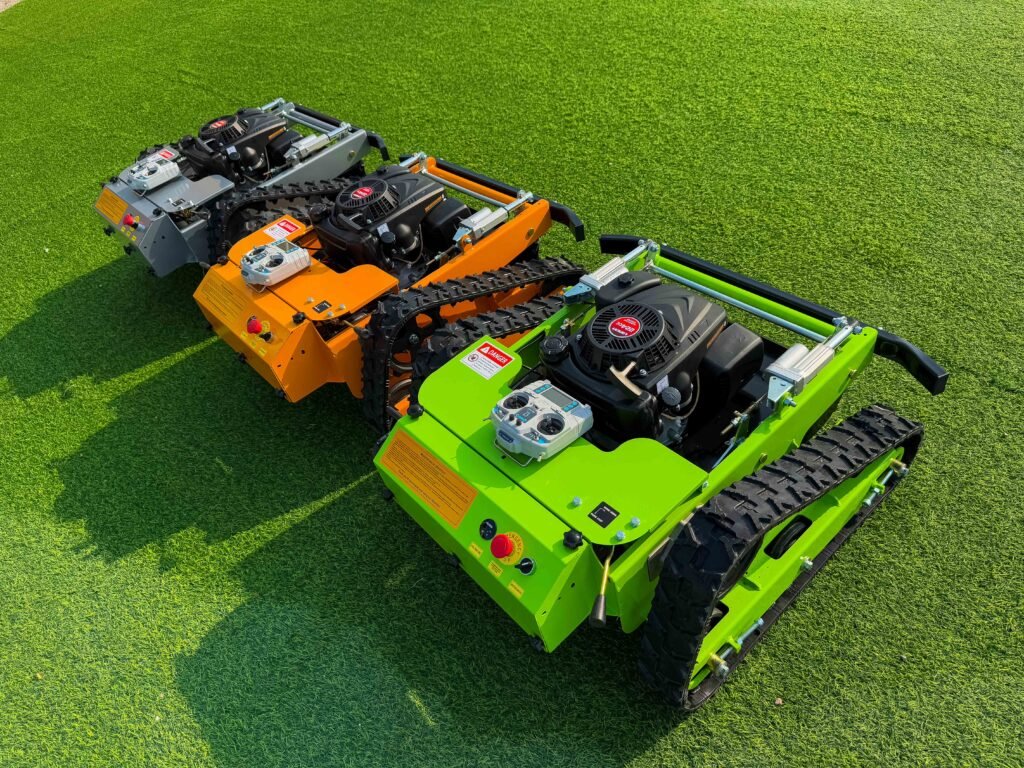
A lot of buyers hear “remote-controlled mower” and imagine one category. In reality, it’s three different machines, and mixing them up is how budgets get wrecked:
A) Remote-controlled slope mowers (commercial)
These are the tough ones—the machines designed to keep operators off dangerous slopes and rough ground. Think steep embankments, roadside maintenance, solar farms, railways, utility right-of-ways. Brands like SPIDER sit here, and the pricing shows it (more on that in a second).
B) Remote-controlled walk-behind style mowers (prosumer / light commercial)
These are more “yard + small acreage” focused. They’re typically battery-electric, controlled by a handheld remote, and priced like premium consumer equipment. Mowrator is an example in this middle zone.
C) Robotic mowers (boundary wire / RTK / app controlled)
Many Western brands dominate this segment (like Husqvarna Automower). They’re “robotic” rather than “RC,” and they solve a different problem: regular lawn maintenance on defined areas.
Why this matters:
The “save 30–50%” claim is most realistic in Category A (commercial slope mowers) and sometimes Category B—because Western commercial slope machines can be very expensive, and the feature set is often overkill for certain jobs.
2) The Price Reality: Western Brands vs. the Rest
Let’s anchor expectations with real, public pricing (because guessing is how people get misled).
Western / established commercial slope mowers
SPIDER lists machines in the tens of thousands. For example, one model is listed around $36,998 USD (discounted from ~$39,998) on a US product page.
Another reseller list shows models ranging roughly from $24,700 up to $59,570 depending on configuration.
European pricing examples also show “from” pricing like 34,800 € for certain models.
Prosumer / light commercial RC mowers
Mowrator-style RC mowers are often in the $2,400–$3,500 range depending on battery and drivetrain.
Robotic mowers (not RC, but often compared)
Premium robotic mowers can also be pricey, especially higher-end AWD models aimed at steep slopes.
So where can “30–50% savings” show up?
Mostly when comparing Western commercial slope mowers (often $25k–$60k) against a Chinese-built alternative that covers the same job without extra premium systems, dealer overhead, or brand markup.
3) Where the 30–50% Savings Actually Comes From
If a Chinese RC mower is truly cheaper, it’s usually because of structure, not magic.
1) Manufacturing ecosystem
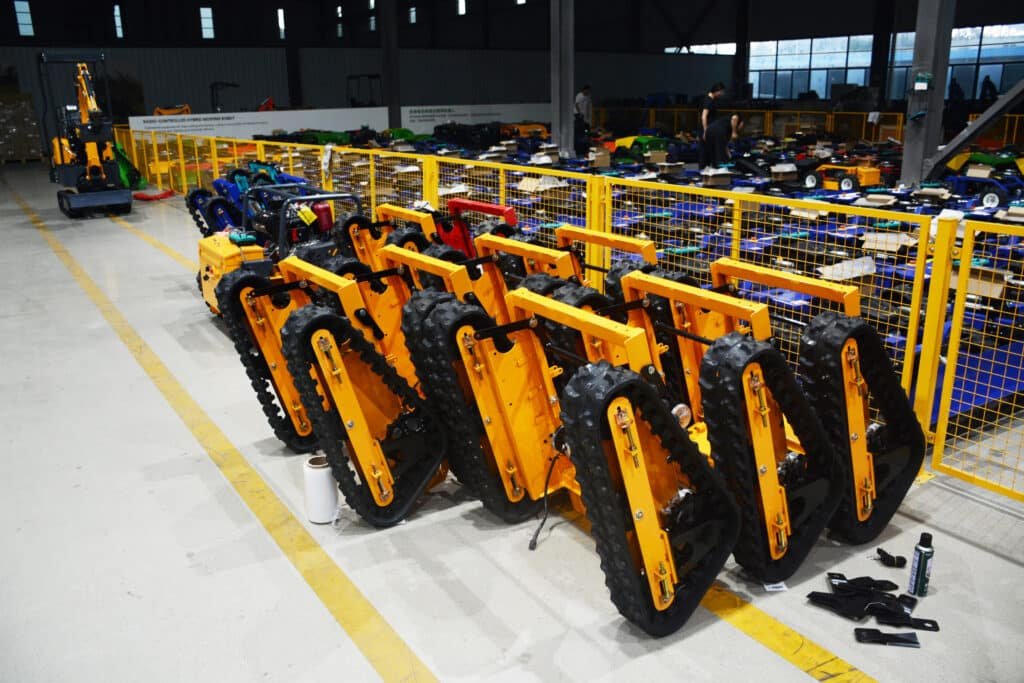
China’s supply chain for frames, motors, gearboxes, batteries, controllers, and wiring harnesses is brutally efficient. The parts are often sourced locally, and factories build similar platforms across multiple products.
2) “Feature trimming” (the quiet secret)
Western brands often bundle:
- higher-end telemetry
- specialized safety interlocks
- premium suspension/traction systems
- dealer-supported diagnostics
- long documentation packages and certifications
A Chinese alternative may offer the core mowing function plus basic safety, and skip the premium layer unless the buyer asks (and pays) for it.
3) Channel cost
Western pricing often includes:
- dealer margin
- local warehousing
- service trucks and tech labor
- marketing + financing programs
A direct import model strips many of those costs out—but it shifts responsibility to the buyer (especially for support and compliance).
4) Different warranty economics
Some Chinese factories offer shorter warranties or “parts-only” approaches unless a distributor program is negotiated.
Reality check:
Savings are easiest when the buyer is a dealer/importer who can handle parts, service, and documentation properly.
4) When a Chinese RC Mower Is the Smart Buy (best-fit scenarios)
Here are the situations where Chinese RC mowers most often beat Western brands on total cost—without turning into a headache.
Scenario 1: “Commercial slope mowing, but not extreme”
If the job is:
- slopes that are challenging but not insane
- grass + light brush (not thick saplings all day)
- predictable terrain (not constant rocks/stumps)
…then the Western “top tier” machine can be overkill.
Scenario 2: Dealer/importer with service capability
If there’s already:
- a small workshop
- a mechanic who can handle basic drivetrain + electronics
- a parts shelving system
…then direct sourcing starts to make financial sense fast.
Scenario 3: Fleet buyers who standardize parts
If multiple machines will be purchased (even 5–20 units per season), a buyer can:
- lock a parts kit list
- negotiate spare parts bundles
- standardize consumables (belts, blades, motors, wheels)
That’s where the savings become real and repeatable.
Scenario 4: Buyers who treat compliance as a “project,” not a checkbox
In the EU, buyers can’t treat CE as a sticker. A remote-controlled mower includes radio equipment (the remote link), and that triggers extra obligations.
If the buyer is comfortable managing paperwork and testing paths, Chinese sourcing becomes far less risky.
5) When Western Brands Still Win (and you shouldn’t fight it)
Sometimes paying more is cheaper.
Western brands are often the better deal when:
- The mower will run 8 hours/day, 5–6 days/week on nasty terrain.
- Customers demand local service response and a dealer network.
- Insurance, municipal contracts, or tender documents require recognized certifications, standardized documentation, or proven field history.
- The buyer cannot afford downtime during peak season.
For commercial slope mowing, downtime is expensive. If one missed week costs more than the price difference, the “cheap” mower becomes the expensive one.
6) The Non-Negotiables: Safety, Compliance, and Liability
This is where many import deals go wrong: buyers focus on the machine price and forget the legal side.
EU: Machinery rules are real—and changing
EU machinery safety is governed by a framework that’s moving from the old directive (2006/42/EC) toward Machinery Regulation (EU) 2023/1230, with application dates coming in 2027.
EU: Remote control = Radio Equipment Directive (RED)
If the mower uses a radio remote (it does), RED applies. RED sets essential requirements for:
- health & safety
- electromagnetic compatibility
- efficient use of radio spectrum
Translation into buyer language:
A “CE certificate” that ignores RED is a red flag—because the remote link is part of the product.
US: OSHA doesn’t have a single “robot mower rule”
OSHA notes there are no specific robotics standards, but relevant general industry standards still apply depending on workplace and hazard profile.
Safety standards you’ll see referenced
- ANSI/OPEI B71.4 (commercial turf care equipment safety) is commonly referenced in the commercial mower world.
- Robotic mower safety standards exist too (different product type), like ANSI/OPEI 60335-2-107 for robotic battery powered lawnmowers.
Important: Standards and laws vary by market. The point is not to memorize numbers—it’s to force the supplier to prove the product is built for the market, not just “works in a video.”
7) A Practical Buyer Checklist (factory + machine + paperwork)
This is the part that saves money and prevents regret.
A) Machine reality checks (ask for proof, not promises)
- Slope rating: ask “max slope in degrees” and “max slope with wet grass.” Many brands advertise the best-case number. SPIDER, for example, talks about slopes up to 60°.
- Cutting productivity: acres/hour or m²/hour under real conditions.
- Battery/engine details: if electric, ask for IP rating and thermal protection; if engine, ask emissions market suitability.
- Remote control range + failsafe: what happens if the signal drops? stop? brake? blade stop?
- Emergency stop locations: on remote and on machine.
B) Factory checks (the “quiet reliability” stuff)
- Incoming inspection: batteries, motors, controllers, harness connectors
- Welding consistency on frame (critical for vibration + fatigue life)
- Water/dust protection and harness routing (mowers live in dirt and moisture)
- End-of-line test: blade motor load test, drive motor heat, remote link stability
This is where factories that already build compact machinery platforms tend to be stronger—because they’re used to structure, vibration, and harsh environments. That’s also why sourcing partners with factory DNA—like Nicosail’s manufacturing mindset in compact equipment—are often a safer reference point when building a sourcing checklist, even if the product category differs. (In plain English: the same quality habits travel well.)
C) Paperwork checks (where fraud usually hides)
For EU-facing orders, ask for:
- EU Declaration of Conformity (DoC) that clearly lists applicable directives/regulations (Machinery + RED, and others where relevant).
- Test reports that match the exact model (not “similar series”)
- Technical file outline (risk assessment, manuals, diagrams)
If the supplier gets defensive, that’s a signal.
8) Parts, Service, and Downtime: The Hidden Budget Line
A mower can be 40% cheaper and still lose money if parts take 3 weeks.
The minimum spare parts kit that prevents panic
For each machine, budget a starter kit that includes:
- blade set (multiple)
- belts (if belt drive)
- key sensors / remote receiver module
- drive motor or gearbox wear parts (depends on design)
- throttle/drive controller module (common failure point on harsh jobs)
- wheels/track components (if tracked)
- switches + E-stop components
Dealer trick: add a “parts kit line” to every sale. Customers hate downtime more than they hate paying for spares when it’s explained clearly.
Support model options
- Option 1: Local dealer service (best customer experience, higher margin)
- Option 2: Parts-only warranty (works for contractors with mechanics)
- Option 3: Swap-unit strategy (keep one backup machine; fastest uptime)
9) Shipping, Duties, and Season Timing: Don’t Lose the Peak Window
Many buyers “save money” and then miss the mowing season.
Common failure points:
- ordering too late (production + sea freight eats weeks)
- unclear packaging leading to damage claims
- battery shipping complications (if lithium)
- missing documentation for customs clearance
Practical strategy:
For seasonal markets, importers often do best by placing:
- a pre-season stock order (best pricing + stable planning)
- a smaller mid-season replenishment order (only fast movers)
This is the exact place where experienced export factories shine—not by being cheap, but by being predictable. Nicosail’s export model in compact machinery (Europe/North America/Australia) is a good example of the kind of supplier discipline buyers should look for: consistent documentation, stable lead times, and shipment planning habits—because those habits prevent the “missed season” disaster.
10) Recommended Buying Strategy for Importers & Dealers
If the goal is 30–50% cost advantage without blowing up risk, the safest playbook looks like this:
Step 1: Pick the “right comparison”
Compare Chinese RC mowers to:
- premium commercial slope mowers priced $25k–$60k (where savings can exist)
Not to: - basic walk-behind mowers from big-box retail
Step 2: Start with a pilot batch (not a container)
Do:
- 1–3 units for internal testing
- build a real spare parts list from failures
- validate documentation quality
Step 3: Lock configuration
The fastest way to create chaos is letting every order change:
- motor type
- remote system
- battery pack
- cutting deck
Standardize 1–2 configurations. That’s how dealers make money and keep tech support simple.
Step 4: Negotiate like a pro (focus on total package)
Instead of fighting only on unit price, negotiate:
- spare parts bundle ratio
- response time for parts shipping
- documentation completeness
- remote control compliance evidence (especially for EU)
FAQs (What buyers ask right before they decide)
1) Is “30–50% savings” realistic, or just marketing?
It can be real when the comparison is against premium commercial slope mowers that publicly list in the $25k–$60k band.
For prosumer RC mowers already around $2.4k–$3.5k, savings exist but usually won’t be that dramatic.
2) What’s the biggest risk with importing a Chinese remote-controlled mower?
Not the mower “working.” The biggest risk is compliance + liability: CE/RED gaps in the EU, weak documentation, or unclear safety behavior on signal loss.
3) Does a remote-controlled mower automatically need RED compliance in Europe?
If it intentionally transmits/receives radio waves for control (typical remote control), RED is relevant. The European Commission’s RED page explains it sets requirements for safety/health, EMC, and spectrum use
4) Are there specific OSHA rules for robotic/RC mowers in the US?
OSHA notes there are no specific robotics standards, but other OSHA rules and safety practices still apply depending on hazards and workplace.
5) What if customers demand “recognized standards” for safety?
In commercial contexts, ANSI/OPEI B71.4 is commonly referenced for turf care equipment safety; robotic mower standards also exist for that product class.
6) How should dealers handle service if they import direct?
The simplest model is:
- sell with a starter spare parts kit
- offer parts-only warranty unless the dealer has a service shop
- keep one “swap unit” for high-value customers
This keeps uptime high and complaints low.
7) Where does Nicosail fit into this, if the topic is lawn mowers?
Nicosail is relevant as a reference for what good factory practice looks like in compact machinery exports: stable QC routines, documentation discipline, and predictable lead times—exactly the habits needed to make a cost-saving import program succeed without quality surprises.
Summary (The clean decision rule)
A Chinese remote-controlled lawn mower can beat Western brands on cost—sometimes by 30–50%—when the target is commercial slope mowing and the buyer has the ability to manage parts, compliance, and service like a real importer, not a casual shopper. Western brands still win when downtime is catastrophic, contract requirements are strict, or local service support is non-negotiable.
The best results come from treating this like a system:
- compare the right category
- pilot test first
- standardize configuration
- lock parts + paperwork early
That’s how cost savings turn into real profit—without turning into a season-killing problem.


