
1. Introduction: A Quiet Shift in the Landscaping World
Something interesting is happening on job sites, farms, and municipal green spaces.
More and more landscapers—especially those dealing with slopes, rough land, or long mowing hours—are quietly switching from traditional walk-behind or ride-on mowers to RC (remote control) lawn mowers. And not just any RC mowers. A growing number are coming straight from China.
This isn’t about chasing the lowest price. Most professional landscapers already know cheap machines cost more in the long run. This shift is about control, safety, efficiency, and business math that finally makes sense.
Let’s break down why this is happening, without technical jargon, without marketing fluff—just straight talk from how these machines are built, sold, and actually used.
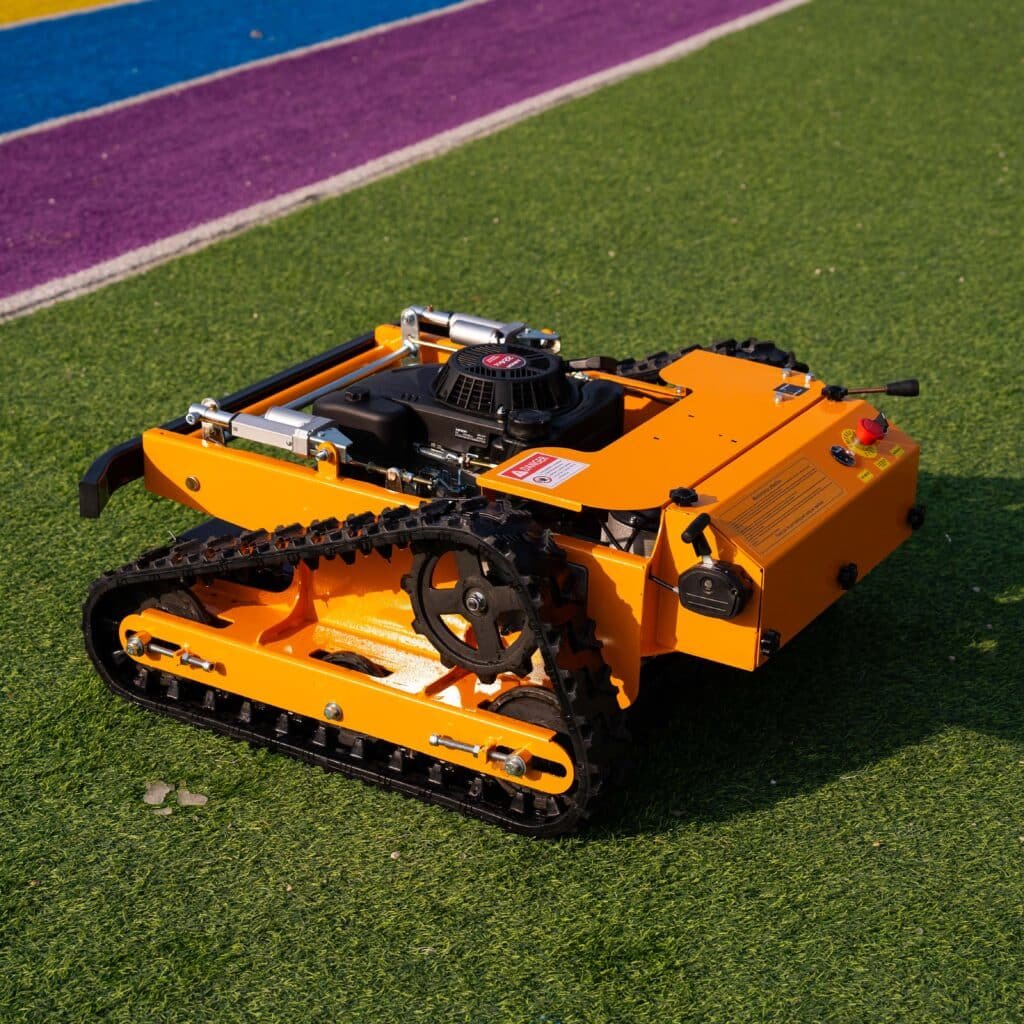
2. What Exactly Is an RC Lawn Mower? (Plain Talk Version)
An RC lawn mower is simple in concept:
- No operator sits on it
- No one walks behind it
- The operator stands at a safe distance
- The mower is controlled by a remote
Most RC mowers use:
- Tracked undercarriage (like a mini excavator)
- Gasoline or diesel engines
- Heavy-duty flail or rotary cutting systems
Think of it less like a “robot” and more like a small unmanned work machine.
No AI. No complicated apps. Just reliable remote control.
3. Why Traditional Mowing Is No Longer Enough
For years, landscapers relied on:
- Ride-on mowers
- Walk-behind brush cutters
- Handheld trimmers
These still work fine—on flat lawns.
But today’s jobs are different:
- Highway slopes
- Solar farms
- Riverbanks
- Abandoned land with rocks and weeds
- Steep vineyards and orchards
These jobs create three big problems:
- Safety risk
- Labor fatigue
- Low productivity per hour
RC mowers solve all three at once.
4. The Real Reason China Is Winning This Market
China didn’t win this market by accident.
It happened because:
- China already builds tracked machines at scale
- Factories supply parts to global brands first
- Engineering experience comes from construction equipment, not toys
Most RC lawn mowers use:
- Gearboxes adapted from mini tracked machines
- Frames welded on excavator production lines
- Engines already used in generators and compact machinery
This matters because:
- Parts are proven
- Failures are predictable
- Designs evolve fast
European brands were first to market.
Chinese factories were first to industrialize it.

5. Cost Isn’t Cheapness: Understanding the Price Advantage
Many buyers hear “China” and think “cheap.”
That’s not accurate.
The real advantages are:
- Lower labor cost
- In-house component production
- No multi-layer brand markup
A European RC mower might cost:
- €18,000–€25,000
A well-built Chinese RC mower:
- €6,000–€10,000
Same job.
Same concept.
Different cost structure.
That price gap allows landscapers to:
- Buy two machines instead of one
- Recover investment faster
- Reduce financial risk
That’s why rental companies are paying attention.
6. Performance Where It Actually Matters
On paper, many machines look similar.
In real use, landscapers care about:
- Maximum slope angle
- Track grip
- Engine cooling
- Cutting consistency
Chinese RC mowers perform well because:
- Tracked systems are wide and low
- Engines are oversized, not minimal
- Cooling systems are simple, not delicate
On steep slopes, simplicity beats sophistication.
7. Safety First: Why RC Mowers Reduce Real Jobsite Risk
This is the part insurance companies love.
RC mowing:
- Removes the operator from the danger zone
- Prevents roll-over injuries
- Reduces vibration exposure
For slope work, this is critical.
Many landscapers didn’t switch because they wanted new machines.
They switched because:
- One injury can end a business
- One claim can destroy profit
RC mowers aren’t a luxury.
They’re a risk management tool.
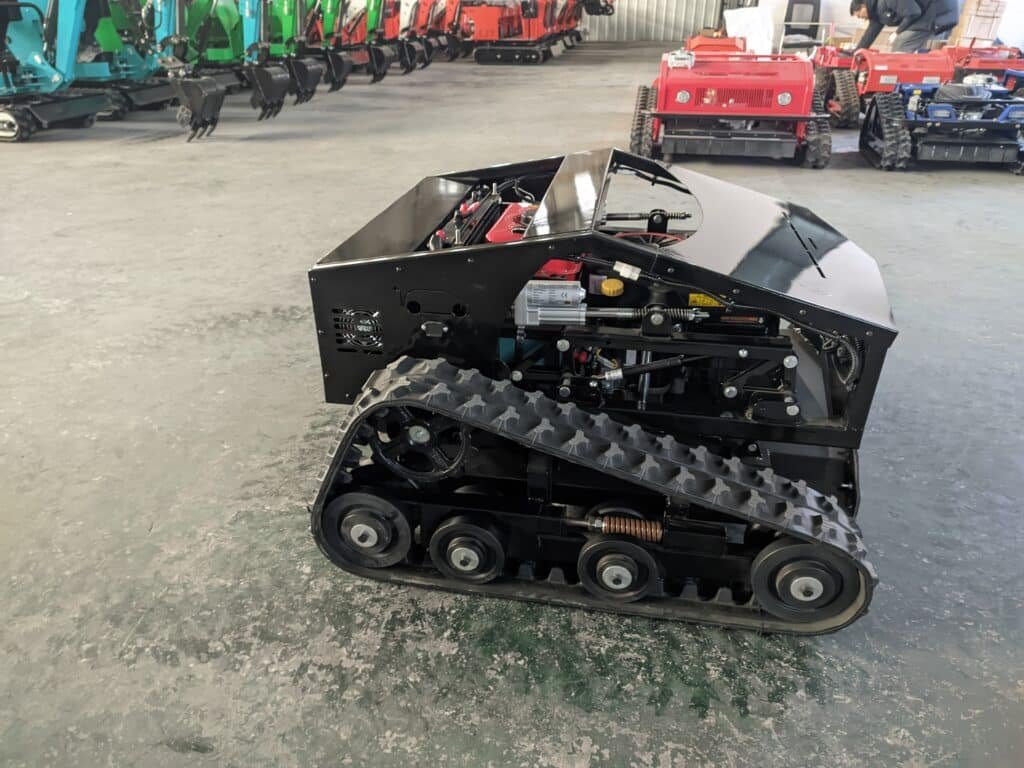
8. Durability: What Factory Data and Field Use Reveal
Here’s something many buyers don’t realize:
Chinese factories test RC mowers like construction machines, not garden tools.
Common internal testing includes:
- Continuous 8–10 hour running cycles
- Track wear simulation
- Gearbox heat stress testing
Why?
Because many factories also build:
- Mini excavators
- Compact loaders
Those standards carry over.
A mower built on a “toy mindset” fails fast.
A mower built on a “machine mindset” lasts.
9. Customization: Why Landscapers Want “Their Own” Machine
One reason China stands out is customization.
Factories can offer:
- Custom colors
- Private labels
- Different cutting heads
- Engine options
This is especially valuable for:
- Rental companies
- Dealers
- Municipal suppliers
Instead of selling “someone else’s brand,” buyers sell their own solution.
That flexibility is rare in Western manufacturing.
10. Certification, Compliance, and Export Reality
This is where smart buyers slow down.
A good China RC mower must have:
- CE compliance
- EMC testing
- Engine emission compliance
Serious factories provide:
- Real certificates
- Traceable test reports
- Matching serial numbers
This is non-negotiable for Europe and North America.
Reliable manufacturers understand this.
Unreliable traders avoid the topic.

11. After-Sales Support: The Part Everyone Worries About
Let’s be honest:
This is the biggest concern.
The reality today:
- Most RC mowers are mechanically simple
- Spare parts are modular
- Engines are globally available
Good suppliers:
- Ship spare parts with the machine
- Provide exploded diagrams
- Offer video support
The biggest mistake is not choosing China—
It’s choosing the wrong supplier.
12. Why European & North American Buyers Are Switching
Buyers from Germany, Canada, and Australia are practical.
They care about:
- Downtime
- Payback period
- Customer complaints
Once they realize:
- The machine does the job
- The risk is manageable
- The numbers work
The decision becomes easy.
This isn’t a trend driven by hype.
It’s driven by spreadsheet logic.
13. Where Brands Like Nicosail Fit In
Some Chinese factories focus only on volume.
Others focus on export reliability.
Brands like Nicosail sit in the middle:
- Factory-based production
- Experience with tracked machines
- Familiar with EU and North American buyers
This matters because:
- Communication is smoother
- Documents are cleaner
- Expectations are realistic
Not every buyer needs the same supplier.
But experienced exporters reduce headaches.
14. Common Buying Mistakes First-Time Importers Make
Here are mistakes seen again and again:
- Choosing the lowest quote
- Ignoring spare parts
- Not checking certificates
- Underestimating shipping time
RC mowers are machines, not gadgets.
Treat them like equipment,
and they’ll pay you back.
15. Who Should Consider a China RC Lawn Mower—and Who Shouldn’t
Good fit if:
- You mow slopes regularly
- Labor is expensive
- Safety matters
- You think long-term
Not ideal if:
- You only cut flat residential lawns
- You want a “plug-and-play” consumer toy
- You don’t want to manage imports
RC mowers are professional tools.
They reward professional thinking.
16. Frequently Asked Questions (FAQ)
Q1: Are China RC lawn mowers reliable long-term?
Yes—if sourced from real factories with machinery experience, not trading companies.
Q2: How steep a slope can they handle?
Most handle 30–45 degrees, depending on weight and track design.
Q3: Is after-sales support realistic from China?
With proper spare parts and documentation, yes. Many issues are simple mechanical fixes.
Q4: Are these machines hard to learn?
No. Most operators learn basic control in under one hour.
Q5: Why are prices so much lower than European brands?
Lower manufacturing cost and fewer brand layers—not lower quality by default.
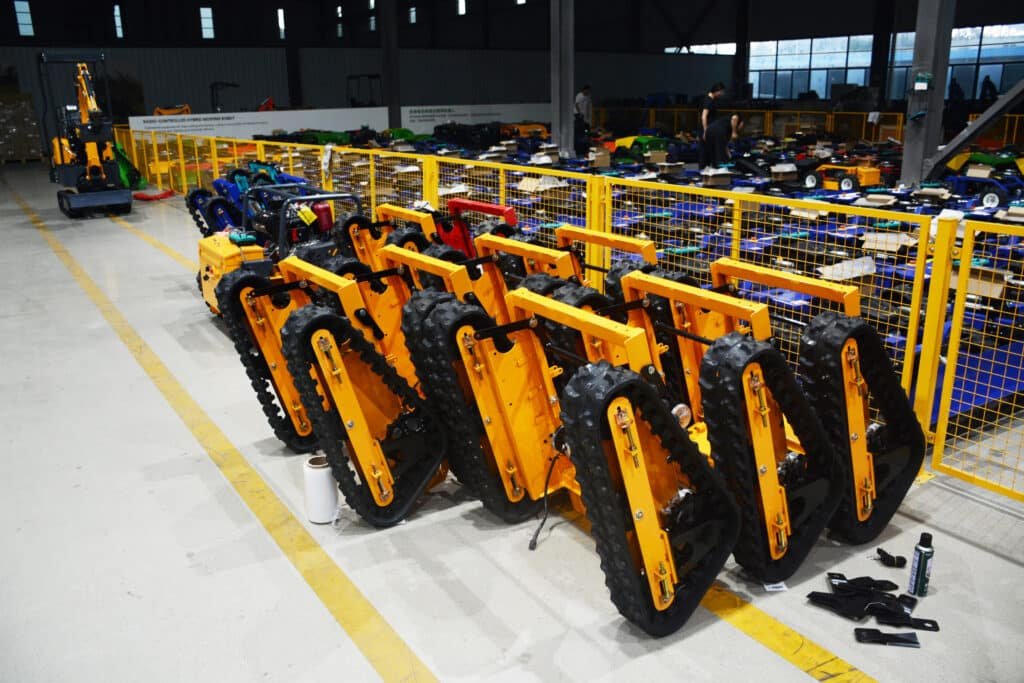
17. Final Summary: Is the Trend Real or Just Hype?
More landscapers are turning to China RC lawn mowers because:
- The machines work
- The math makes sense
- The risk is manageable
- The flexibility is unmatched
This isn’t about chasing cheap equipment.
It’s about buying smart tools for modern landscaping problems.
For many professionals, RC mowing isn’t the future anymore.
It’s already the present.


