
When buyers compare a China RC lawn mower with a traditional lawn mower, the first thing they usually look at is purchase price. That is normal. But it is also where many people make the wrong decision.
A mower is not just a machine cost. It is a labor tool, a safety tool, a maintenance item, and in many jobs, a machine that decides whether a site can be cut quickly, slowly, or not at all. So the real question is not “Which mower is cheaper to buy?” The better question is “Which mower is cheaper to own and use for the kind of ground that needs to be cut?”
That is where the comparison gets interesting.
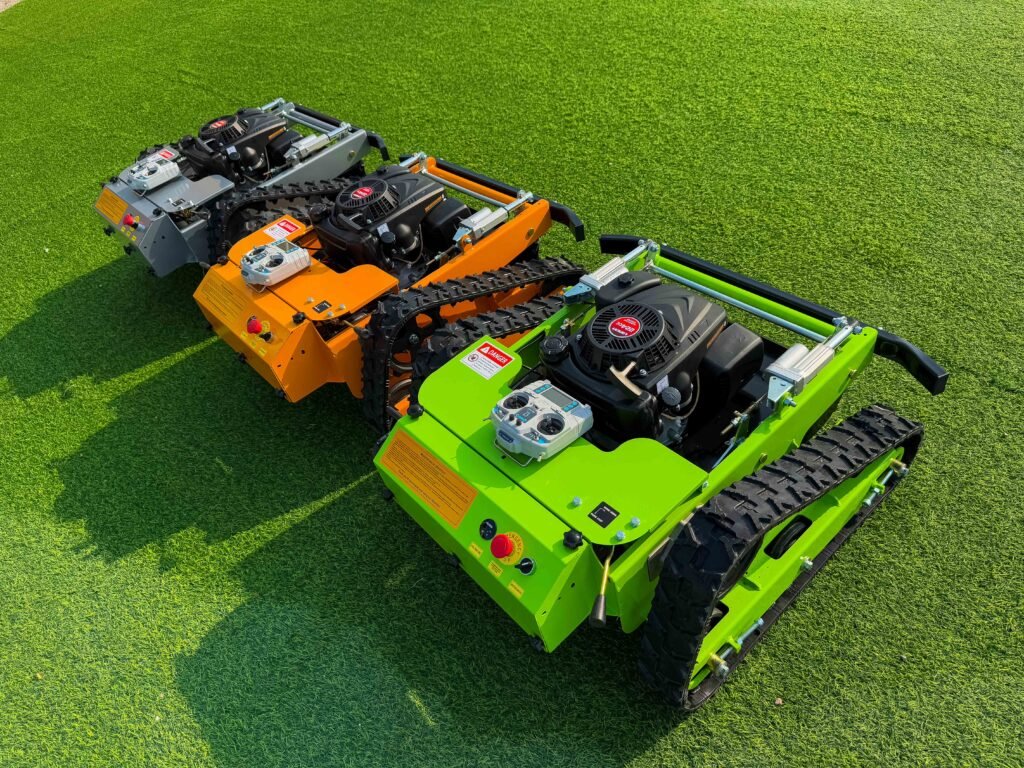
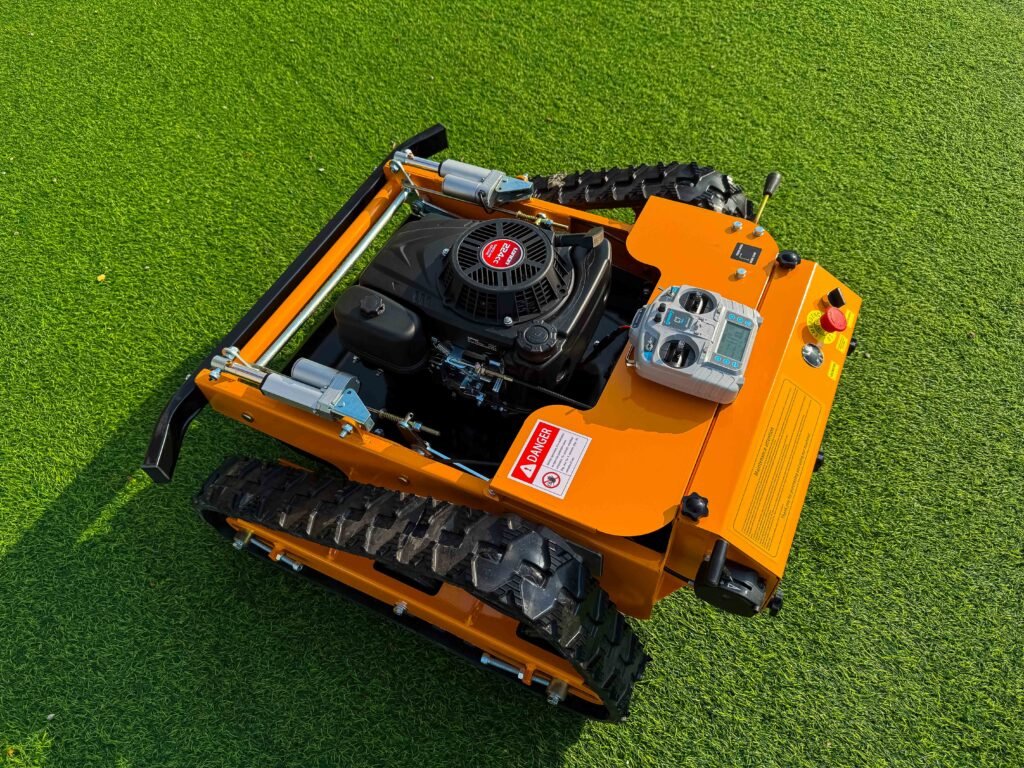
For this article, “China RC lawn mower” means a China-made remote-controlled mower, usually a tracked machine designed for slopes, rough ground, orchard rows, solar farms, roadside banks, pond edges, and other places where walk-behind or ride-on mowing gets slow, risky, or simply impractical. It is not exactly the same thing as a small robotic garden mower that runs by itself inside a neat backyard boundary. RC mowers are more like working machines for difficult ground. That difference matters a lot when talking about cost-effectiveness. Yanmar, for example, describes radio-controlled mowers as a response to labor-intensive mowing on sloped land, while California’s transportation research says remote-control mowers show strong promise for safe and efficient vegetation management on steep slopes and constrained areas.
What makes this comparison so different?
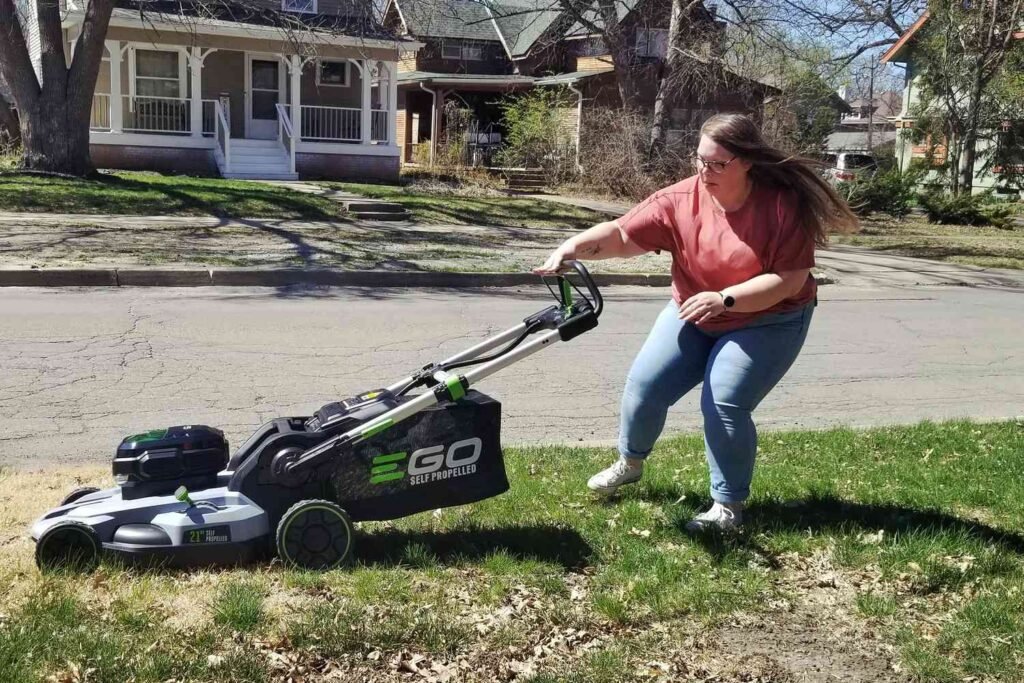
A traditional lawn mower usually fits one of three categories: a walk-behind mower, a ride-on lawn tractor, or a zero-turn/riding mower. These machines are familiar, easy to find, and often cheaper at the start. For flat lawns and simple grounds, they still make a lot of sense. But traditional mowers also have clear limits. OSHA says that when slope limits are unknown, riding mowers should be kept off slopes over 15 degrees, and the National Association of Landscape Professionals says riding mowers are typically limited to about 15 degrees while walk-behind mowers are typically limited to about 20 degrees. NALP also notes that mower injuries remain serious, with about 70,000 emergency-room treatments and around 90 deaths annually in the U.S., many involving overturns or run-overs.
That one point changes the whole money discussion. On flat ground, a traditional mower is often the lower-cost answer. On steep banks, river edges, rough orchard land, solar sites, and uneven embankments, the traditional mower can turn into the expensive answer because it needs slower work, more trimming, more caution, and sometimes a second machine or extra labor to finish the same job safely. Remote-controlled slope mowers are built for exactly this gap. Official manufacturer pages from SPIDER and AS-Motor list working capability up to about 55 to 60 degrees on some models, far beyond normal riding mower guidance.
Why sticker price is only half the story
A China RC lawn mower usually costs more than a basic push mower and more than many standard lawn tractors. That part is obvious. So if the buyer only looks at invoice value, the traditional mower often seems like the winner.
But total cost is made up of five things:
Purchase cost
This is the price everybody sees first.
Labor cost
This is the cost many buyers underestimate. The U.S. Bureau of Labor Statistics says the median hourly wage for grounds maintenance workers was $18.50 in May 2024. That means every extra labor hour on every mowing visit adds up faster than many buyers think.
Maintenance cost
This is where engine service, blade wear, track wear, belts, filters, oil, spark plugs, and batteries start to matter.
Downtime cost
A cheaper machine that sits still during the growing season is often the most expensive machine in the yard.
Risk cost
This includes rollover risk, operator fatigue, awkward hand trimming on steep banks, and damage from using the wrong mower in the wrong place. OSHA and NALP both make it clear that slope mowing is one of the most dangerous parts of mower work.
This is why a China RC lawn mower can be either a smart buy or a bad buy. If it replaces dangerous, slow, labor-heavy mowing on slopes, it can be very cost-effective. If it is bought for a flat private lawn where a normal mower already works fine, then it may be overkill.
Where China RC lawn mowers save real money
1. On steep slopes, they can change the job completely
This is the biggest cost advantage.
Traditional riding mowers are strongly limited on slopes. Walk-behind machines can handle a bit more, but they still have practical and safety limits. RC slope mowers, by design, move the operator away from the machine and let the machine do the dangerous part. Caltrans specifically evaluated remote-control mowers because steep slopes were too hazardous or otherwise unfeasible for tractor-based mowing, and it concluded these machines showed strong promise for safe and efficient work on steep slopes and constrained sites. SPIDER and AS-Motor publish slope capabilities well beyond traditional mower ranges.
That means the cost comparison is not really “RC mower versus ride-on mower” on steep banks. In many cases, it is “RC mower versus a slower and riskier mix of brush cutters, walk-behind work, partial hand finishing, and repeated passes.” Once that is understood, the math changes quickly.
2. They can reduce labor pressure on difficult sites
Yanmar’s technical review describes slope mowing as a labor-intensive task and explains that its RC mower development focused on stability and controllability on sloped land. That lines up with what contractors already know in the field: hard terrain eats labor. Rough ground slows the operator, increases fatigue, and often forces extra trimming or follow-up work.
If a traditional method needs two people for a tricky site, or one person plus a lot more time, an RC mower may cut the labor per visit even if the machine itself costs more. With labor benchmarked around $18.50 per hour in the U.S., even small time savings repeated across a full mowing season can become real money.
3. They open up jobs that traditional mowers handle badly
Remote-controlled slope mowers are commonly promoted for roadsides, river banks, solar power stations, parks, heavy brush, and other hard-to-reach areas. SPIDER lists roads and highways, extreme slopes, solar power stations, river banks, and dam walls among its main applications. That is important because a machine becomes more cost-effective when it can cover more job types instead of sitting idle waiting for the “perfect” condition.
For distributors and rental buyers, this matters even more. A machine that solves a real site problem is easier to rent out, easier to explain to customers, and less likely to be compared only on headline price.
4. The right RC mower can lower the safety burden of the job
This should not be turned into a sales slogan, but it should not be ignored either. Safety has a cost. Rollovers, slips, overreaching on slopes, and mowing near drop-offs are not just training issues. They affect insurance risk, crew confidence, and whether the job can be done smoothly at all. OSHA warns against operating riding mowers beyond manufacturer slope limits and says to avoid slopes over 15 degrees if no guidance is available. NALP also highlights overturns and run-over incidents as a major source of serious injury and death.
That is why RC mowers are often most cost-effective in places like orchards, vineyards, reservoir banks, roadside shoulders, and solar farms. The value is not only in cutting grass. The value is in cutting grass without putting the operator where the danger is highest. Caltrans’ assessment points in the same direction.
5. Some powertrain choices can reduce operating cost even more
Not every China RC lawn mower uses the same power setup. Some are gasoline. Some are hybrid. Some newer models are fully electric. That matters for operating cost.
Gasoline-powered mowers still need normal small-engine service. Briggs & Stratton says small-engine oil changes are recommended every year or every 25 hours of operation, and its tune-up guidance includes changing the air filter. That is basic, normal maintenance, but it is still time and money.
Battery-powered equipment can reduce some of that routine work. Husqvarna says battery products have fewer moving parts, need much less maintenance and service, and eliminate daily maintenance tied to combustion systems such as cleaning cylinder fins, filters, or spark plugs. Raymo also describes its commercial radio-controlled mower concept as fully electric, silent, clean, and inexpensive to operate.
So, when a buyer compares a China RC mower with a traditional gas mower, the best answer may depend partly on the power system. A gasoline RC mower can still be cost-effective because of slope productivity. But an electric or hybrid RC mower may improve the numbers further where fuel, noise, or maintenance hours are major concerns.
Where traditional lawn mowers still win
This part matters because not every customer needs an RC mower.
For a small flat residential lawn, a traditional mower is usually still the cheaper and smarter choice. The machine costs less, the operation is simple, local dealers are easy to find, and the terrain does not justify a specialized tracked machine. A buyer who only cuts easy ground a few times a month may never recover the extra purchase cost of an RC mower.
Traditional mowers also win when service convenience matters more than terrain capability. If a local dealer can supply parts the same day for a common ride-on mower, that convenience has value. A low-cost import stops being cheap very quickly if parts support is slow during peak season. That is one of the main reasons buyers should compare support cost, not just purchase cost.
In plain words: if the grass is flat and easy, traditional mowing is still hard to beat. If the grass is steep, rough, wet-edged, narrow-access, or dangerous, the balance starts moving toward the RC mower.
The hidden costs buyers often miss
This is where many first-time importers get caught.
Shipping, customs, and local delivery
A China RC lawn mower may look very attractive at factory price, but freight, customs duty, inland transport, and unloading can change the landed cost quickly.
Parts availability
Blades are easy. The real question is about controllers, pumps, motors, harnesses, drive components, track rollers, and remote-control parts.
Training
An RC mower is easy to understand in theory, but good operation still needs practice. Bad remote use can cause track wear, rough cutting, or poor productivity.
Supplier honesty
A machine can look good in photos and still be weak in wiring, hydraulic routing, remote response, paint protection, or documentation.
These are exactly the points serious buyers should ask about before placing an order. The same buying discipline that professional importers expect from reliable compact-equipment suppliers such as Nicosail also applies here: real factory evidence, clear parts lists, honest videos, realistic delivery times, and after-sales support that still answers the phone after payment.
A simple ROI example
Here is a very simple example, just to make the idea practical.
Suppose a contractor maintains 10 steep sites, with 30 mowing visits per year. Suppose a China RC lawn mower saves only 1.5 labor-hours per visit compared with the traditional mix of slower mowing and hand finishing.
That is:
10 sites × 30 visits × 1.5 hours = 450 labor-hours saved per year
Using the BLS median wage of $18.50 per hour, that equals:
450 × $18.50 = $8,325 per year in labor value.
And that example is actually conservative. It does not include reduced trimming time, lower fatigue, faster completion on rough banks, or the cost of avoiding slow manual methods on steep slopes.
Now look at the same math on a flat residential lawn. If the RC mower saves only a few minutes each time, the payback becomes weak. That is why the best buyers always match the machine to the terrain.
What to check before importing from China
1. Ask for a real slope demo
Not just a flat-ground video. Ask for mowing video on a slope close to your real working condition.
2. Check center of gravity and track design
Yanmar’s review shows how seriously manufacturers treat weight balance and center-of-gravity layout for slope stability. That is not a small detail. It is one of the core design points in an RC mower.
3. Confirm the powertrain
Gas, hybrid, or electric? Your maintenance cost, noise level, and daily operating routine will change depending on this choice. Briggs & Stratton’s small-engine service guidance shows what gas ownership involves, while Husqvarna’s battery guidance shows why some buyers prefer electric systems.
4. Ask about wear parts in writing
Blades, belts, tracks, batteries, bearings, filters, remotes, seals, and hydraulic hoses should all be listed clearly.
5. Ask how after-sales works outside China
Will the supplier ship parts fast? Is troubleshooting done by video? Are manuals and wiring diagrams in clear English? This affects real cost more than many buyers expect.
6. Match the mower to the job, not to the trend
Some buyers see RC mowing as a “new technology” purchase. That is the wrong mindset. It should be treated as a job-fit purchase. If the site is steep and difficult, it can be a money-saving tool. If not, it can become an expensive toy.

FAQ
Are China RC lawn mowers cheaper than traditional lawn mowers?
Usually not at the purchase stage. A traditional mower is often cheaper to buy. But a China RC lawn mower can be more cost-effective over time when the job involves steep slopes, rough terrain, difficult access, or heavy labor use.
When does a China RC lawn mower make the most financial sense?
It makes the most sense on slopes, embankments, river banks, solar farms, orchards, and other places where normal riding or walk-behind mowing is slow, risky, or incomplete. Traditional riding mowers are typically limited to around 15 degrees, while some RC slope mowers are designed for much steeper ground.
Are traditional lawn mowers still better for some buyers?
Yes. For small, flat, easy lawns, a traditional mower is usually the more practical and lower-cost option.
Do RC lawn mowers reduce labor cost?
They often can, especially on difficult terrain. Yanmar describes slope mowing as labor-intensive, and Caltrans found remote-control mowers promising for safe and efficient work on steep and constrained sites.
Are battery RC mowers cheaper to maintain than gas mowers?
In many cases, yes. Husqvarna says battery equipment has fewer moving parts and avoids maintenance items like spark plugs and filters tied to combustion systems. Gas small engines still need routine oil and tune-up service.
What is the biggest buying risk with a China RC lawn mower?
Usually it is not the steel. It is support: parts speed, troubleshooting, manuals, and whether the supplier gives real after-sales help during the mowing season.
Final thoughts
The cost-effectiveness of China RC lawn mowers vs. traditional lawn mowers depends on one thing above all: the ground being cut.
If the work is flat, light, and simple, traditional mowers still win on purchase price and simplicity.
If the work is steep, rough, narrow, risky, or labor-heavy, a good China RC lawn mower can be the better money machine even when the invoice price is higher. That is because the real savings usually come from labor efficiency, safer slope work, less awkward hand finishing, and better access to places normal mowers should not be doing in the first place. OSHA, NALP, Yanmar, and Caltrans all point in the same general direction: slope mowing is where the traditional approach starts showing its limits, and where remote-controlled mowing begins to make economic sense.
So the smart way to buy is simple: do not ask which mower is cheaper. Ask which mower makes the job cheaper, safer, and easier to finish all season long. That is the question serious buyers should bring to any supplier—and it is the same practical, factory-minded way of thinking that strong export-oriented equipment partners like Nicosail understand best.


