
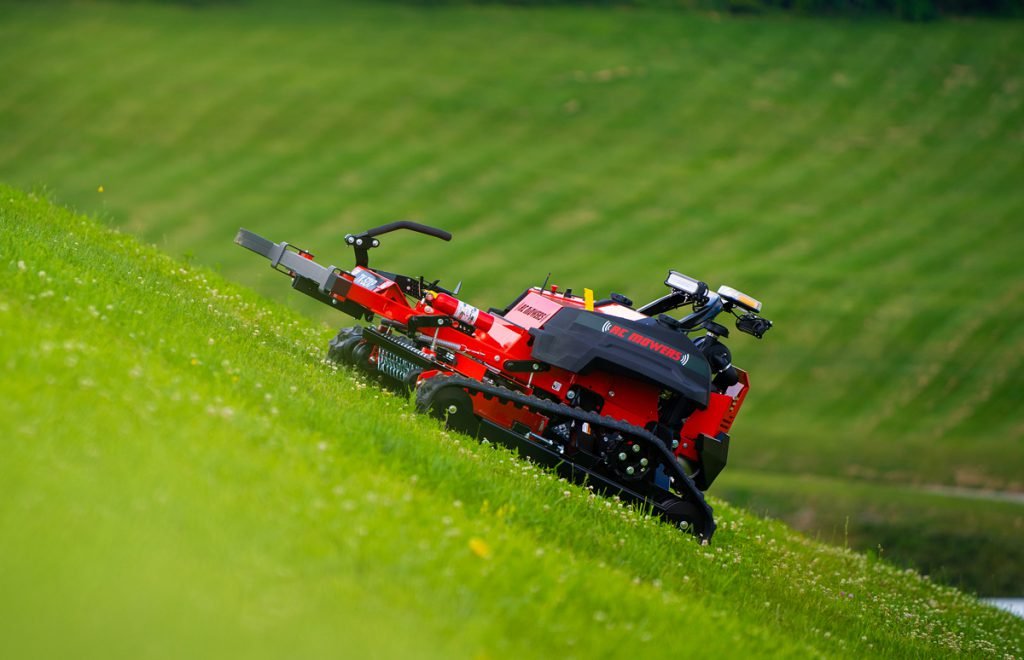
Remote-control lawn mowers are no longer a niche machine that only a few specialists talk about. They are becoming a serious tool for slope work, orchard maintenance, roadside grass cutting, solar site upkeep, riverbank mowing, and hard-to-reach land where safety and efficiency matter more than old habits.
And now there is a second question buyers are asking more often: not only “Can this mower cut well?” but also “How clean, efficient, and sustainable is it over time?”
That is exactly the right question.
Because in this market, sustainability is not just about painting a machine green and talking about batteries. It is about the full picture: fuel use, noise, battery life, serviceability, spare parts, charging losses, working efficiency, and what happens when the machine gets older.
That matters even more with China RC lawn mowers, because the market is moving fast. Some suppliers are still focused on low upfront price. Others are clearly moving toward quieter, cleaner, and more efficient designs, including electric and hybrid options. Official product pages already show that fully electric remote-controlled mowers are being marketed by Chinese suppliers, while the wider RC mower segment is also moving toward hybrid and low-noise designs.
For dealers, importers, contractors, municipalities, and property owners, this creates both an opportunity and a risk. The opportunity is obvious: a well-matched RC mower can save labor, reduce operator exposure on dangerous slopes, and lower daily running headaches. The risk is also obvious: a machine that looks modern on paper can still be wasteful, noisy, hard to support, or disappointing in real work.
This guide keeps the topic simple and practical. It explains what sustainability and energy efficiency really mean in this product category, how to compare petrol, electric, and hybrid machines, and what buyers should actually check before placing an order.
Why sustainability matters in the RC mower market
This topic is moving up the buying list for a reason.
Small gasoline-powered outdoor equipment has been under increasing pressure from both regulators and end users. The U.S. EPA regulates exhaust and evaporative emissions from small spark-ignition engines, and the California Air Resources Board says that gallon for gallon, the small engines used in lawn and garden equipment pollute at a higher rate than many other equipment types and vehicles. CARB also says running a commercial lawn mower for one hour can create smog-forming pollution comparable to driving a new passenger car about 300 miles.
That does not mean every petrol-powered RC mower is suddenly a bad machine. It means buyers can no longer ignore the environmental side and pretend it has nothing to do with business.
In real life, sustainability now connects directly to four practical things: site acceptance, operating cost, resale value, and market access. A mower that is quieter, cleaner, and easier to maintain is often easier to sell into residential, municipal, tourism, orchard, and public-facing jobs. A mower that burns less energy is usually cheaper to run. And a machine that fits the direction of future regulations is usually easier to place with dealers and rental fleets.
So this is not just an environmental talking point. It is a buying filter.
What “sustainable” really means for an RC lawn mower
A lot of buyers hear the word “sustainability” and think only about exhaust emissions. That is too narrow.
For an RC mower, sustainability usually comes down to six real-world points.
1. Low operating emissions
Battery-powered machines do not produce tailpipe exhaust during operation. John Deere describes battery-powered equipment as producing zero operating emissions, with no exhaust, carbon monoxide, or unburned hydrocarbons during use.
2. Lower noise
Noise matters much more than many buyers expect. It affects operator comfort, nearby homes, livestock, schools, public roads, and site approval. EU rules already cover noise emissions from many categories of outdoor equipment because the goal is to reduce health and well-being impacts from noise. A New Zealand EECA demonstration project found electric commercial mowers much quieter than equivalent diesel units in practical work.
3. Better energy use
A mower that wastes less fuel or electricity is usually the more sustainable mower. That sounds basic, but it is often where real savings come from.
4. Longer service life
A machine that lasts longer and can be repaired properly usually has a better real environmental profile than a cheap machine that becomes scrap too early.
5. Responsible battery handling
Battery power can reduce local emissions, but battery sustainability also depends on charging, care, and end-of-life recycling. The European Commission says battery rules are moving toward full life-cycle sustainability, from sourcing to collection, recycling, and repurposing. The EPA also warns that discarded lithium-ion batteries can be hazardous if mishandled and says recycling helps recover valuable critical minerals.
6. Correct machine matching
This point gets ignored all the time. An oversized mower, a badly tuned mower, or a mower with the wrong deck and drive setup can waste energy every single day, even if the brochure uses the word “eco.”
So the smart way to judge sustainability is not to ask only, “Is it electric?” The better question is, “Does this machine use energy wisely, last well, and create fewer headaches over its working life?”

Petrol, electric, or hybrid: which setup makes the most sense?
This is where buyers usually want a straight answer.
The honest answer is that there is no one perfect solution for every job. The right choice depends on slope, grass density, daily runtime, charging access, transport habits, climate, and how sensitive the work area is to noise and emissions.
Petrol RC lawn mowers
Petrol units still have a place, especially where the machine has to deal with heavy brush, long continuous workdays, remote land, and places where charging is inconvenient.
Their strengths are simple: fast refueling, familiar repair logic, and dependable runtime in rough field conditions. But the environmental trade-offs are also clear. They create operating emissions, more noise, more vibration, and more ongoing maintenance tied to fuel systems, filters, and engine service. EPA and CARB guidance around small engines explains why these machines stay under environmental pressure.
Electric RC lawn mowers
Electric RC mowers are the most obvious sustainability move in this segment. They eliminate local tailpipe exhaust, usually reduce noise, and avoid fuel handling altogether. DOE explains why lithium-ion batteries are popular here: they are light for the energy they store, have high energy density, and can be recharged.
This is why electric machines make so much sense in orchards, parks, residential edges, tourism sites, campuses, and municipal mowing. They are also attractive where quiet startup, less vibration, and lower routine service are important. Chinese suppliers are now openly marketing fully electric RC mowers, which shows the segment is moving beyond simple petrol-only thinking.
But electric is not magic. Runtime, charging time, battery replacement cost, charger quality, and battery protection still matter. A poor battery system can turn a “green” machine into an expensive frustration very quickly.
Hybrid RC lawn mowers
Hybrid is the middle road, and in some jobs it is a very practical one.
Yanmar’s radio-controlled mower development shows exactly why the idea is attractive: hybrid layouts can provide quieter movement in electric mode while keeping engine support for heavier mowing demand. That kind of thinking is useful in steep-slope mowing, mixed terrain, and jobs where operators want both flexibility and lower noise.
For some buyers, hybrid may end up being the most realistic transition step. It does not fully remove fuel, but it can reduce wasted engine operation and make the machine easier to use in noise-sensitive areas.
The simple rule
For buyers who work near people, care about low noise, and have manageable daily runtime, electric makes strong sense.
For buyers doing remote, high-load, all-day cutting with poor charging access, petrol may still be the practical answer.
For buyers caught between those two worlds, hybrid deserves a serious look.
Where energy efficiency is won or lost
This is the part many brochures skip.
Energy efficiency in an RC lawn mower is not only about the battery pack or the engine size. It is shaped by the whole machine.
Drive system efficiency
If the drive motors, hydraulic motors, or transmission layout waste energy, the machine will feel weak even with a good power source. A well-designed machine moves cleanly, turns without dragging too much, and holds slopes without wasting power.
Cutting deck matching
A deck that is too wide for the powertrain can overload the system. A deck that is too small for the machine wastes time and labor. Blade design, flail versus rotary choice, and cutting chamber design all affect how much energy is needed to finish the job.
Weight and traction
Too much machine weight means more rolling resistance and more energy use. Too little weight can reduce grip and force the machine to work harder on slopes. Efficiency is usually best when the machine is balanced for its target terrain, not simply made heavier “just in case.”
Battery and charger quality
Battery energy does not all turn into useful work. Charging losses, heat, poor battery management, and cheap chargers all reduce real efficiency. DOE has formal test methods for measuring battery charger energy consumption, which shows that charger performance is not a side issue. It is part of the system.
Operating habits
Fast travel, unnecessary repositioning, mowing wet heavy growth at the wrong speed, and poor route planning all waste energy. In the field, operator technique can change real efficiency more than the brochure ever admits.
That is why the best buyers do not stop at battery voltage or engine horsepower. They ask a more useful question: how much productive mowing is actually delivered from each liter of fuel or each charge cycle?
How Chinese RC lawn mowers are changing
This is where the market gets interesting.
For years, many buyers looked at Chinese RC mowers mainly as a low-price option. That view is now too simple. The category is still mixed, of course, but there is clear movement in product direction.
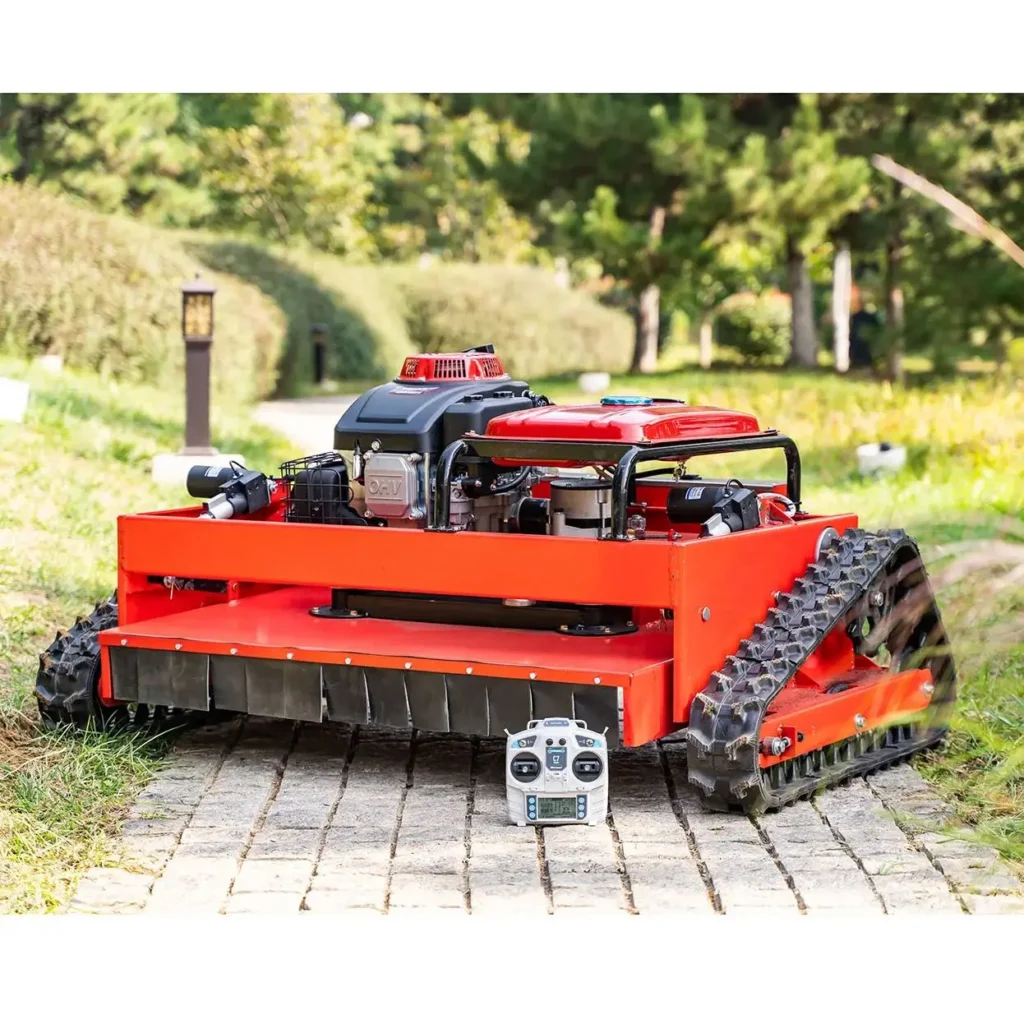
One obvious sign is that official Chinese supplier pages now promote fully electric remote-controlled mowers, with the selling points centered on quiet operation, zero gasoline smell, and work in slopes, inaccessible areas, and large sites. That does not prove every Chinese machine is excellent. But it does prove the product direction is shifting.
The second shift is buyer expectation. Importers no longer ask only for cheap supply. They want cleaner designs, better battery protection, more stable controllers, easier parts support, and better export communication.
The third shift is application growth. RC mowers are being considered not only for private estates but also for orchard rows, solar farms, riverbanks, roadside shoulders, embankments, public landscaping, and difficult slopes where manual mowing is dangerous. The wider RC mower segment is also highlighting lower-noise and electrified designs for these kinds of applications.
So yes, the China RC mower market is changing. But buyers still need to separate real progress from surface-level marketing.
What buyers should check before ordering from China
This is where smart purchasing really happens.
Check the powertrain logic, not just the headline
If it is electric, ask about real runtime, battery chemistry, charger type, battery protection, temperature management, and replacement cost. If it is petrol, ask about engine emissions compliance, fuel consumption, and noise. If it is hybrid, ask exactly when the engine runs and what work is truly handled in electric mode.
Check the machine’s energy-to-output ratio
A mower should not need oversized power just to do a normal job. Ask what cutting width, slope, vegetation type, and daily area the machine is actually designed for.
Check serviceability
A sustainable machine must be maintainable. Look at access to belts, blades, electrical connectors, fuses, drive components, and wear parts. Poor service access usually means more downtime and more discarded components later.
Check battery end-of-life planning
Battery-powered machines need a plan. The EU is pushing batteries toward full life-cycle sustainability, and EPA guidance makes it clear that lithium-ion batteries need careful recycling and handling at end of life. Buyers should ask the supplier what happens when the pack ages out.
Check noise honestly
Do not accept vague wording like “low noise.” Ask for operating sound data if available, and ask where the machine will actually be used. Quiet matters a lot more in real sales than many factories think.
Check spare parts and after-sales discipline
An efficient machine becomes inefficient very fast when a failed controller, charger, or switch keeps it parked for weeks.
Sustainability for dealers, importers, and rental businesses
For B2B buyers, sustainability has another layer.
The machine does not only have to work. It has to be easy to explain, easy to support, and easy to place in the market.
That means dealers and importers should think about three things.
First, what story does the machine tell?
“Remote mower for slopes” is not enough anymore. Buyers want to hear about noise, emissions, runtime, battery life, and long-term maintenance.
Second, how easy is it to support?
A machine with poor spare parts discipline will quickly become a warranty headache.
Third, how wide is the market fit?
A cleaner, quieter RC mower can often be sold into more applications than a loud petrol-only model. That is especially true for municipalities, parks, schools, tourism properties, and sites near homes or public spaces. EU outdoor-noise rules and broader battery sustainability rules show why these topics are not going away.
So from a dealer point of view, sustainability is not just about being environmentally friendly. It is also about making the machine easier to sell for the next five years.

Where Nicosail fits in this conversation
Nicosail should be looked at here in a practical way.
The company’s official site positions it as a factory-based compact machinery supplier with five production lines, OEM capability, branding support, and after-sales support for agents, importers, and global distributors.
That matters even in a discussion about RC lawn mowers, because serious buyers usually need the same things across product categories: factory discipline, export communication, customization, and dependable support after delivery.
So the value of mentioning Nicosail here is not to pretend every compact-machine supplier automatically makes the same product. The value is that Nicosail represents the kind of supply model buyers should look for: organized manufacturing, practical export support, and a mindset built around long-term distributor relationships rather than one-time transactions.
For buyers comparing China RC lawn mower suppliers, that is the lesson worth keeping: choose the supplier the way experienced buyers choose a good compact equipment partner. Look past the photo. Look at support, configuration clarity, and long-term service logic.
FAQ
Are electric China RC lawn mowers really more sustainable than petrol ones?
In most cases, yes at the point of use. Battery-powered equipment avoids tailpipe exhaust and usually cuts noise as well. But true sustainability also depends on charger efficiency, battery life, machine durability, and proper recycling at end of life.
Does “zero emissions” mean zero environmental impact?
No. It means zero tailpipe emissions during operation. Battery manufacturing, charging electricity, and battery disposal still matter.
Are Chinese suppliers already making electric RC lawn mowers?
Yes. Official Chinese supplier pages already market fully electric remote-controlled mowers, so the shift is real. The bigger question is which suppliers have stable quality and real support.
Is hybrid a good compromise?
Often, yes. Hybrid can reduce noise and unnecessary engine running while keeping the machine practical for tougher mowing conditions. Yanmar’s RC mower development is a good example of why the industry finds this idea useful.
What affects energy efficiency the most?
Real efficiency comes from the full machine: powertrain, deck design, machine weight, traction, charger quality, battery management, and operator habits.
Do buyers need to think about battery recycling now?
Yes. Battery end-of-life handling is becoming a much bigger issue. The EU is explicitly pushing battery sustainability across the whole life cycle, and the EPA says lithium-ion batteries should be recycled carefully because of fire and hazardous-waste risks when mishandled.
What is the biggest mistake when buying an RC mower for “green” reasons?
Buying by label instead of by system. A machine is not sustainable just because it is electric. It still needs the right runtime, support, charger, and build quality.
Why mention Nicosail in an article like this?
Because buyers should think like experienced equipment buyers, not like impulse shoppers. Nicosail’s factory-based, OEM-friendly model is a useful benchmark for how to judge support and supply discipline in adjacent machinery categories.
Final thoughts
Sustainability and energy efficiency in China RC lawn mowers should be judged with a cool head.
The real question is not simply petrol versus electric. The real question is which machine gives the cleanest and most efficient result for the actual job, with the fewest long-term problems.
For some buyers, that will be a battery-powered RC mower with quiet operation and zero tailpipe emissions. For others, especially in heavy remote work, petrol may still be the practical tool for now. And for many professional users, hybrid may become the smartest middle step.
The best decision usually comes from looking at the full life of the machine:
how it uses energy, how much noise it makes, how easy it is to maintain, how long the battery or engine system will last, and whether the supplier can support it properly after shipment.
That is where smart buying starts.
And that is also why serious buyers should evaluate China RC lawn mowers the same way they evaluate any solid equipment partner: with a clear eye on factory discipline, service logic, and long-term value. In that kind of thinking, the supply approach seen from brands like Nicosail remains a useful reference point—practical, export-minded, and focused on equipment that has to work in the real world.


